Select Language:
Construction has begun on a new “super factory” for a Chinese brain-computer interface startup, set to become operational in the latter half of this year. This facility will enable advanced BCI technology to transition from research labs into mass production.
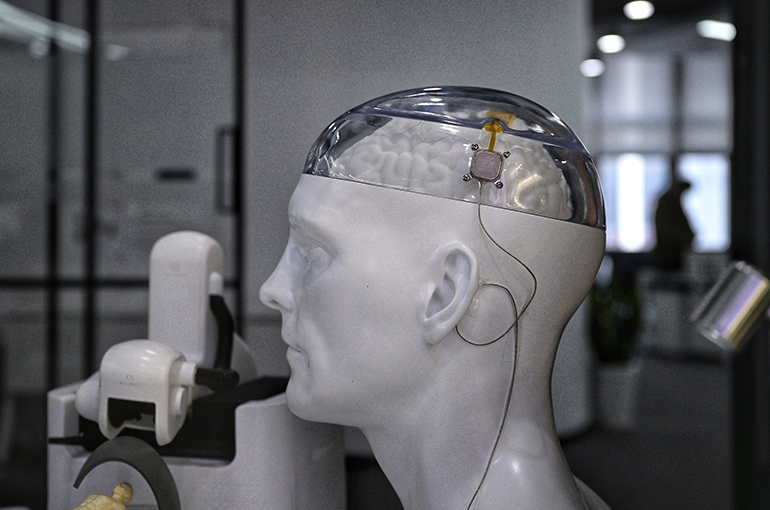
The initial phase of the plant, covering approximately 14,300 square meters in southeastern Jiangxi province, will produce the world’s second and China’s first fully implantable BCI device. The company aims to achieve stable production runs reaching tens of thousands of units.
Beyond that, the factory will manufacture various products, including high-throughput, flexible implantable electrodes, high-frequency electroencephalograph devices, and surgical robots for implantation procedures. It will also serve as a data center, focusing on optimizing algorithms and advancing next-generation innovations through neural signal data collection, processing, and analysis.
A comprehensive rehabilitation training center will be part of the facility, designed to simulate real-life and work environments. This will assist patients with implanted BCIs in rebuilding their daily life skills and reintegrating into society with dignity.
Founded in 2021, the company has completed over 50 human BCI implant surgeries in collaboration with medical institutions. Late last year, it successfully implanted China’s first fully implantable BCI device with a built-in battery, marking only the second such achievement globally, after Elon Musk’s Neuralink.
The BCI sector is approaching a phase of large-scale application, aided by advancements in technology. Recently, Musk announced that Neuralink will commence mass production of BCI devices this year.
Chinese firms are actively competing in this field, with the Shanghai government releasing an action plan on January 10 to promote BCI development. The plan aims for semi-invasive devices to reach clinical use by next year and the full clinical application of all types of BCI devices by 2030.
 ChatGPT
 Perplexity
 Gemini AI
 Grok AI