Select Language:
During the Labor Day holiday, Hangzhou, located in eastern China’s Zhejiang Province, introduced a fully operational “robot police squadron” to key areas, enhancing the city’s traffic management capabilities.
This move represents a significant advancement in China’s use of artificial intelligence (AI) to improve public services and urban management.
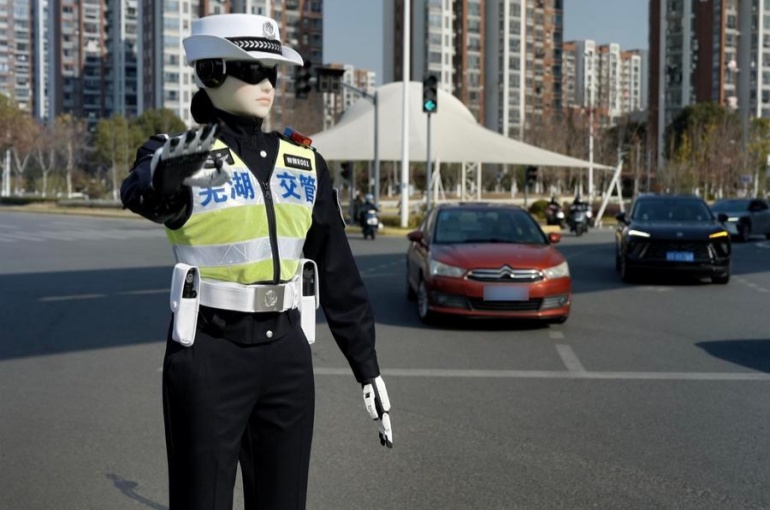
Launched on May 1, the squadron includes 15 intelligent traffic management robots positioned at critical downtown intersections. Their roles involve regulating non-motorized vehicles and pedestrians, giving directions, and assisting human police officers, creating a new model of cooperation between humans and machines.
The robots are customized to meet the specific needs of their locations. At the popular West Lake scenic area, visitors can approach a robot, press a button labeled “I want to speak” on its interactive screen, and request directions. Powered by advanced large language models, the robots swiftly interpret these requests and, using real-time traffic and location data, offer the best walking or public transportation routes through voice and graphical display.
At prominent city intersections, the robots function as law enforcement aides. Equipped with cutting-edge visual recognition technology, they monitor traffic 24/7 to detect violations like electric scooters crossing stop lines or riders without helmets. When a violation is observed, the robot issues an immediate audio warning and can send incident data to a central command for further investigation.
Apart from enforcement and assistance, the robots can also act as traffic signals. Using millisecond synchronization with traffic lights and a library of standard police gestures, they can perform eight predefined commands such as “go,” “stop,” “turn left,” and “turn right.” This ensures their signals are perfectly coordinated with the traffic lights, providing clear guidance to drivers and pedestrians.
Chen Sanchuan, a traffic police officer in Hangzhou, explained that the deployment of these robots has significantly reduced the workload for human officers. Capable of operating continuously for 8 to 9 hours daily, they handle routine tasks, freeing officers to focus on more complex responsibilities that require human judgment.
This deployment is part of a wider national trend. Across China, cities are adopting AI and robotics into their traffic management systems to enhance safety and efficiency, especially during busy holiday periods.
In Kashgar, in China’s northwest Xinjiang Uygur Autonomous Region, a robot dressed in a high-visibility uniform has been directing traffic at a major intersection since the start of the holiday. Featuring a high-definition camera on its head, it performs standard traffic signs smoothly, capturing onlookers’ attention and showcasing the city’s commitment to developing “smart transportation” systems.
Similarly, in Ordos, Inner Mongolia Autonomous Region, two robot traffic police have been active since May 1. Using Internet of Things (IoT) and AI technologies, their responsibilities include directing traffic, providing safety education, and conducting intelligent patrols.
Wu Qingyun, a traffic police officer in Ordos, noted that deploying robot police has improved traffic flow and reduced manpower burdens at intersections, paving the way for more refined urban traffic management.
Jiang Lei, a leading researcher at a national robotics center, emphasized that the use of robot traffic police across multiple cities signifies more than just technological capability in traffic control and voice interaction—it marks a key moment where embodied AI is actively participating in urban governance.
He added, “This trend indicates that robot traffic police are just the beginning, with many other sectors in China likely to accelerate their move toward intelligent transformation.”
 ChatGPT
 Perplexity
 Gemini AI
 Grok AI