Select Language:
China’s economic indicators generally showed signs of slowdown last month after a surprisingly strong first quarter, with declines in industrial output and consumer spending, along with a drop in fixed-asset investment into negative territory.
Industrial production increased by 4.1 percent in April compared to the same month last year, a slowdown from March’s 5.7 percent growth, according to recent data from the National Bureau of Statistics. For the first four months of the year, industrial output grew by 5.6 percent.
Retail sales of consumer goods saw a modest rise of just 0.2 percent, decreasing from 1.7 percent growth in March. Between January and April, sales increased by 1.9 percent. Meanwhile, fixed-asset investment fell by 1.6 percent over the same period, after growing 1.7 percent in the first quarter.
All three indicators fell short of predictions by 13 leading economists surveyed by the news outlet. Their forecasts expected a 5.8 percent rise in industrial production, a 2 percent increase in consumer goods sales, and a 1.7 percent growth in fixed-asset investment.
The slight decline in April’s data is attributed to typical monthly fluctuations, according to Wang Guanghua, a spokesperson for the National Bureau of Statistics, during a press briefing. Despite this, Wang emphasized that broader economic trends still point to a stable overall economy, supported by macroeconomic and structural indicators.
Earlier data had shown that the country’s gross domestic product grew 5 percent in the first quarter compared to the same period last year, surpassing expectations and marking a 0.5 percentage point increase from the last quarter of the previous year. Production and retail sales of consumer goods grew by 6.1 percent and 2.4 percent, respectively, each accelerating by about 1 point from the last quarter of the previous year.
Though domestic and external challenges remain, Wang noted that there are opportunities for economic upgrading through reforms and the strategic use of policy tools designed to manage risks and foster stable growth.
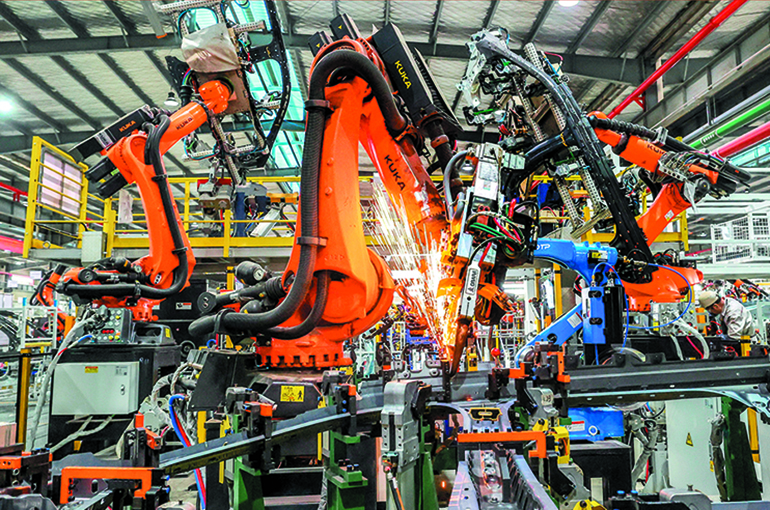
In the first four months, output from equipment and high-tech sectors surged 8.7 percent and 12.6 percent year-on-year, outperforming overall industrial growth by 3.1 and 7 percentage points. Notably, production of 3D printing equipment, lithium-ion batteries, and industrial robots soared by 51 percent, 36 percent, and 26 percent, respectively.
Service sector retail sales grew 5.6 percent in the January-April period compared to last year, slightly up from 5.5 percent in the first quarter. Significant growth was observed in telecommunications and information services, tourism, rental services, cultural and recreational activities, and transportation.
These emerging growth engines are driven by a combination of policy support, market demand, and technological innovation, Wang explained. These deep structural shifts are transforming China’s economic landscape and enhancing the resilience and sustainability of high-quality development.
 ChatGPT
 Perplexity
 Gemini AI
 Grok AI