Select Language:
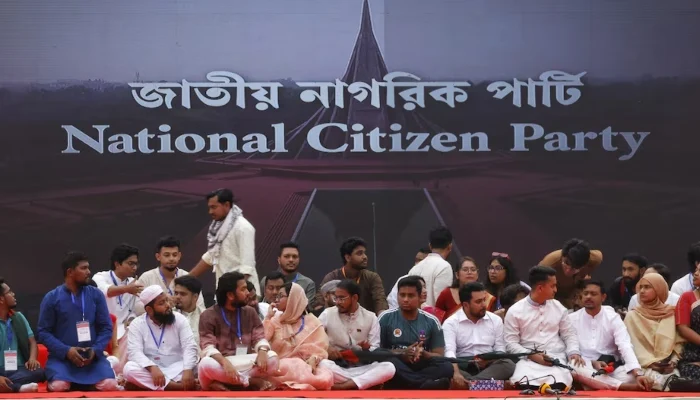
A student-led political party in Bangladesh, born from last year’s protests that led to the removal of Prime Minister Sheikh Hasina, has formed an electoral alliance with Jamaat-e-Islami ahead of February’s parliamentary elections, causing internal disagreements.
Since the protests, the National Citizen Party (NCP) has positioned itself as a centrist, reform-minded alternative to longstanding nepotism and the dominance of two main parties. However, as voting day approaches, the party is struggling to convert its street activism into solid voter support.
NCP leader Nahid Islam announced on Sunday that the party decided to join forces with Jamaat-e-Islami for broader unity, with the final list of candidates set to be released on Monday. Some members describe this alliance as a practical move in an increasingly fractured political environment.
Nevertheless, internal divisions have already surfaced. Tasnim Jara, a doctor who left her medical career in Britain to join the NCP and become a party leader, resigned Saturday and announced she will run as an independent candidate. Several others have also left the party.
Critics argue that this alliance has compromised the core ideals that founding members initially championed. “My moral support for the NCP is gone because this ideological mismatch is too great,” said a university student who preferred to remain anonymous.
Meanwhile, the political landscape is shifting. The Bangladesh Nationalist Party (BNP), which is aligned with the ailing former Prime Minister Khaleda Zia and effectively led by her son Tarique Rahman, is gaining strength following Rahman’s return after nearly 17 years in exile.
The February 12 election will be overseen by an interim government led by Nobel laureate Muhammad Yunus, who took charge after Sheikh Hasina’s departure. Yunus’s role is seen as critical in restoring political stability after nearly two years of unrest.
 ChatGPT
 Perplexity
 Gemini AI
 Grok AI