Select Language:
Bangladesh’s most influential political parties came together on Friday to sign a charter aimed at restoring democracy after the upcoming elections, which are scheduled for next year. This move follows a nationwide uprising that ousted the previous government.
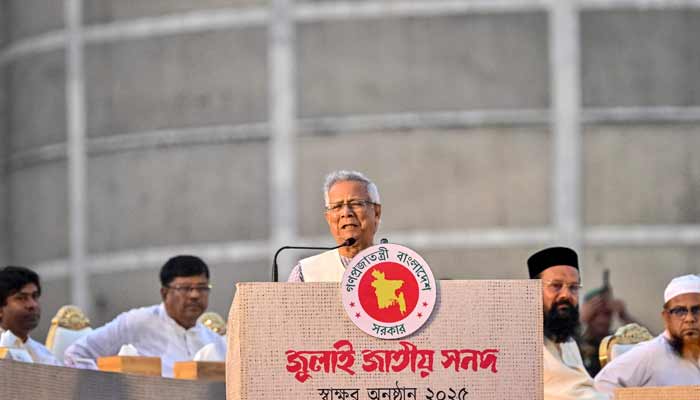
Nevertheless, the celebrations surrounding the Nobel Peace Prize laureate Muhammad Yunus’s government were subdued, as one party chose not to sign and police used tear gas to disperse rock-throwing protesters just before the ceremony.
Yunus, aged 85, described the document as his legacy, emphasizing that he inherited a system in disrepair and insisting that reforms are crucial to prevent a slide back into authoritarianism.
“This marks the beginning of a new Bangladesh,” Yunus declared during the event held in front of the parliament in Dhaka. “We have been reborn.”
The nation of 170 million people has been in a state of political upheaval since Sheikh Hasina was ousted as prime minister in August 2024 after a student-led revolt. The document, known as the “July Charter” after last year’s uprising, has ignited fierce debate among political factions vying for power ahead of the February elections.
Yunus, who has promised to resign following the elections, believes the charter will bolster checks and balances among the executive, judiciary, and legislative branches. It proposes a two-term limit for prime ministers and gives the president additional powers. It also seeks to solidify Bangladesh’s identity as a nation that embraces multiple ethnicities and religions.
The charter was signed by leaders from the Bangladesh Nationalist Party (BNP), one of the leading contenders in the elections, as well as Jamaat-e-Islami, the country’s largest Islamist party. However, the National Citizen Party (NCP), which comprises many students who led the uprising that ended Hasina’s rule, opted to boycott the event.
Prior to the signing, clashes erupted between police and protesters, including those who participated in demonstrations last year demanding justice for injured activists. “The sacrifices of the martyrs are now forgotten,” said Khandakar Mashruk Sarkar, 48.
In a last-minute addition, the charter was amended to include monthly allowances for injured protesters. Its ratification is expected to occur through a referendum or by the newly elected parliament.
Among those watching the event was Mohammad Ibrahim Hossain, 25, an electrician. He admitted to uncertainty about the specific changes the charter would bring and expressed a desire to see less violence.
“I don’t really know what’s in it or how it will benefit us,” Hossain said. “I just want people to stop dying.”
 ChatGPT
 Perplexity
 Gemini AI
 Grok AI