Select Language:
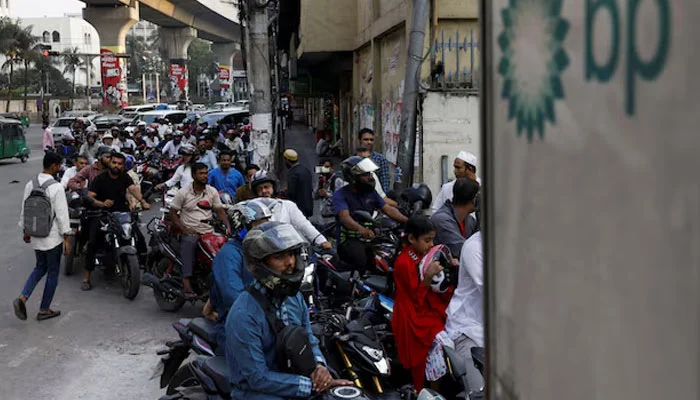
Vehicles form a long line at a fuel station as worries about fuel availability grow amid tensions stemming from the US-Israel conflict with Iran, in Dhaka, Bangladesh, March 6, 2026.— Reuters
– Power outages and diesel shortages are disrupting garment factories.
– Bangladesh is importing diesel to address the fuel shortage.
– The country depends on imports for about 95% of its energy needs.
Bangladesh has started receiving diesel supplies from countries including China and India, with officials stating the current stock can meet roughly one month of demand. Preparations are underway to secure another month’s supply, as the US-Israeli conflict with Iran has interrupted shipments, impacting major industries like the clothing sector.
Home to 175 million people, Bangladesh relies heavily on imported energy, with a dependency rate of around 95%. To cope with the crisis, authorities have implemented vehicle rationing, restricted diesel sales, and shut down universities amid the ongoing turmoil affecting Middle Eastern oil exports.
Many garment manufacturers—second only to China globally—are already reporting inadequate diesel supplies for their backup generators during power outages. Mahmud Hasan Khan, president of the Bangladesh Garment Manufacturers and Exporters Association, noted that power cuts have doubled to as much as five hours daily since the conflict erupted on February 28.
“Our power goes out, so we rely on diesel for our generators, but we just can’t buy enough anymore, which is causing us serious problems,” Khan said.
The Bangladesh Petroleum Corporation (BPC), managed by the government, is currently importing approximately 60,000 metric tons of diesel from three traders. An additional 90,000 metric tons are expected later this month, according to two energy officials who requested anonymity. One shipment of 27,000 metric tons from PetroChina arrived at Chittagong port Monday, while another 28,000 metric tons from Vitol is waiting at the port’s outer anchorage.
Furthermore, about 5,000 metric tons of diesel are being supplied via a cross-border pipeline from India’s Numaligarh Refinery. Negotiations are ongoing to procure an extra 30,000 metric tons from Indian Oil.
“We have enough supplies for one month, and arrangements are being made for an additional month,” a BPC representative said. The agency did not immediately respond to requests for comment.
While Bangladesh generally consumes approximately 380,000 metric tons of diesel each month, figures suggest current consumption has dropped to roughly 270,000 metric tons since rationing began. The ease of securing refined fuel cargoes has been somewhat reassuring, as most traders do not depend on the disrupted Gulf shipping routes responsible for crude oil transportation. Still, prices have risen due to market volatility stirred by the Middle East crisis.
The country also imports about 1.4 million metric tons of crude oil annually under long-term contracts with Saudi Aramco and the Abu Dhabi National Oil Company (ADNOC). However, shipments from these companies could face delays because their cargoes must pass through the Strait of Hormuz. Already, a shipment of approximately 100,000 tons from Aramco has been delayed in the Gulf.
Severe gas shortages have already forced Bangladesh to suspend operations at four out of its five state-run fertilizer factories, diverting gas supplies to power plants instead.
 ChatGPT
 Perplexity
 Gemini AI
 Grok AI