Select Language:
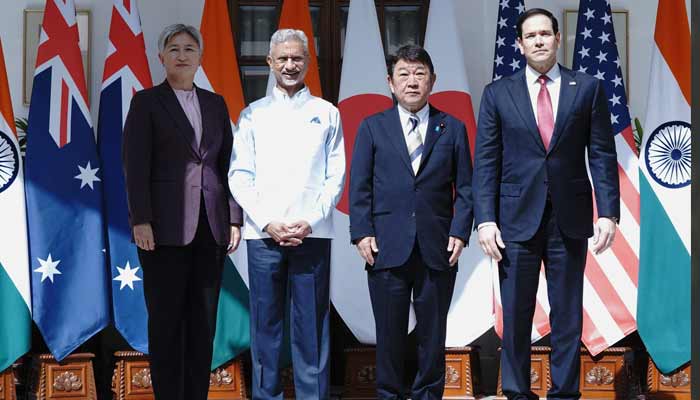
The foreign ministers of Australia, India, Japan, and the United States convened to agree on collaborating on a port project in Fiji and to sign agreements related to critical minerals and energy security. This meeting marked the third gathering of the Quad since September 2024.
During the brief session, the ministers from Australia (Penny Wong), India (Jaishankar), Japan (Toshimitsu Motegi), and the U.S. (Secretary of State Marco Rubio) announced their first joint infrastructure initiative—a port in Fiji. Rubio highlighted that their partnership would focus on port infrastructure, especially addressing the limited port capacity in Pacific Islands, with Fiji as a key collaborator.
The Quad had experienced some slowdown last year after missing a leaders’ summit, partly due to tensions between U.S. President Donald Trump and Indian Prime Minister Narendra Modi over tariffs and other issues. However, Rubio expressed optimism, stating, “We’re beginning to see real progress. We are deeply committed to this partnership, which is a vital part of our global strategy as a nation.”
The ministers agreed to initiate programs on Indo-Pacific energy security and developing a framework for critical minerals. Rubio explained that the minerals framework aims to leverage economic tools and coordinate investments to fortify supply chains, including mining, processing, and recycling of critical minerals. This could be particularly impactful for Japan, which faces disruptions after China ceased shipments of certain minerals vital for aerospace, defense, and semiconductor sectors.
While there’s been advocacy for a high-level visit by Trump to India—potentially linked to a Quad summit—international analysts have questioned whether the absence of a leader-level summit diminishes the group’s significance. The foreign ministers did not comment on plans for a summit this year, but Rubio mentioned that diplomats are working toward scheduling one later this year.
Melbourne-based Asia Society Australia senior policy fellow Premesha Saha noted, “The lack of a leaders’ summit has introduced doubts, but that doesn’t necessarily mean the Quad has lost relevance. If it continues to make progress through ministerial and working-level engagements, it can stay pertinent even without frequent leader-level signals.”
 ChatGPT
 Perplexity
 Gemini AI
 Grok AI