

Select Language:
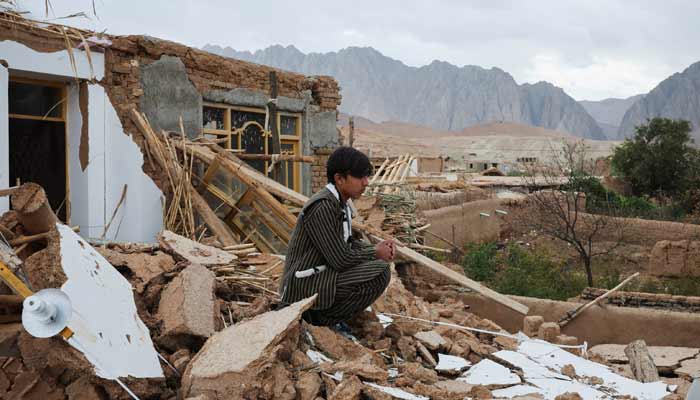
A boy sits beside his damaged home following a powerful 6.3-magnitude earthquake in Samangan Province, Afghanistan, on November 4, 2025.— Reuters
– The earthquake has injured nearly 1,000 people and caused significant structural damage.
– Inadequate infrastructure is making rescue efforts exceedingly difficult, according to officials.
– China has extended aid after the UN committed assistance to Afghanistan.
Residents in northern Afghanistan are working through the debris and tending to the injured after the quake resulted in at least 27 deaths and obliterated hundreds of homes. The tremor hit near Mazar-i-Sharif early Monday, leaving nearly 1,000 hurt and damaging the historic Blue Mosque. The relatively remote epicenter led to a lower death toll than expected.
According to Afghanistan’s National Disaster Management Authority (ANDMA), hundreds of homes have been completely or partially destroyed. Aid organizations expressed concern that the timing is critical, as the coming winter could see temperatures drop below freezing.
Relief efforts are hampered by bad road conditions and damaged infrastructure, with Hosam Faysal, head of Afghanistan at the International Federation of Red Cross and Red Crescent Societies, describing the challenges as “immense.” Faysal added that winter has already complicated rescue operations when speaking from Kabul via video link in Geneva.
The quake also damaged several health facilities, further complicating relief, said Christian Lindmeier from the World Health Organization. Afghanistan’s Ministry of Public Health reports approximately 956 injuries related to the event.
In Tangi Tashqurgan, close to the quake’s epicenter, locals excavated rubble and reinforced weakened structures. Mohammad Yasin, a nearby shop owner, noted multiple buildings had been damaged or destroyed, saying, “If you go inside, you fear they might collapse at any moment.”
This disaster tests Afghanistan’s Taliban-led government, which is already coping with multiple crises, including a deadly earthquake in August that claimed thousands of lives, a sharp decline in foreign aid, and mass deportations of refugees by neighboring countries. The United Nations has pledged support, along with India, which is attempting to improve relations with the Taliban, who remain under Western sanctions. China announced it would also provide aid.
Afghanistan’s rugged mountainous terrain makes it especially prone to natural disasters, with earthquakes being the deadliest, averaging about 560 fatalities annually and causing around $80 million in damages each year. Poor construction practices contribute significantly to high casualty rates, so experts recommend building earthquake-resistant structures and retrofitting existing buildings to mitigate collapse risks.
Compared to August’s quake, Monday’s lower fatality number is partly due to the village’s relatively better construction quality, flatter terrain, and lower population density, according to ANDMA spokesperson Yousuf Hammad.
 ChatGPT
 Perplexity
 Gemini AI
 Grok AI

