Select Language:
US and China Reach Trade Agreement in Geneva
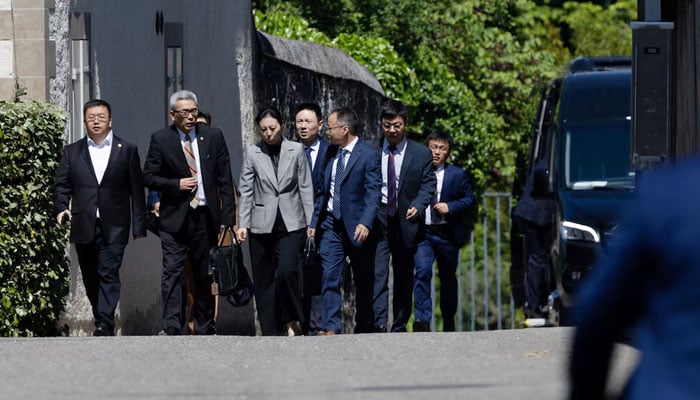
Members of the Chinese delegation exit a residence where trade discussions with US officials took place in Geneva, Switzerland, on May 10, 2025. — Reuters
- Geneva talks heralded as ‘significant advancement’.
- USTR Greer refers to the outcome as ‘a deal we’ve made’.
- Details on China talks to be revealed by Bessent and Greer on Monday.
In a significant development, US Treasury Secretary Scott Bessent and Trade Representative Jamieson Greer announced on Sunday that they have reached a deal with China to reduce the US trade deficit. They characterized the two days of negotiations in Geneva as yielding "substantial progress," although specific details were not shared, according to Reuters.
Bessent informed reporters that the complete information will be disclosed on Monday, noting that President Donald Trump was fully briefed on the "productive discussions" with Chinese Vice Premier He Lifeng and two other Chinese vice ministers.
However, Bessent and Greer did not address the possibility of lowering the hefty US tariffs of 145% on Chinese products, nor the 125% tariffs China imposes on US goods. They did not take questions from the media.
Previously, the US Treasury chief has described these tariffs as being akin to a trade embargo between the two largest economies and emphasized the need for "de-escalation."
Greer described the conclusion of the Geneva talks as "a deal we made with our Chinese counterparts," aiming to decrease the US trade deficit, which amounts to $1.2 trillion in global goods.
"This was, as the Secretary noted, an incredibly constructive two days," Greer remarked. "It’s crucial to recognize how quickly we reached an agreement, indicating that perhaps the differences weren’t as vast as we previously believed." He commended Vice Premier He, along with Vice Commerce Minister Li Chenggang and Vice Finance Minister Liao Min, as "tough negotiators."
This meeting marked the first in-person dialogue between senior economic officials from the US and China since Trump assumed office, during which he initiated a global tariff campaign by declaring a national emergency regarding the US fentanyl crisis, which included a 20% tariff on Chinese imports in February.
Trump also introduced a 34% "reciprocal" tariff on Chinese goods in April, and the subsequent escalations pushed tariffs into triple digits, bringing nearly $600 billion in bilateral trade to a halt.
China had previously demanded any discussions include a reduction in tariffs. On Friday, Trump suggested an 80% tariff on Chinese goods "seems appropriate," marking a notable reduction target proposal.
Greer mentioned that substantial groundwork had been laid prior to the Geneva discussions over the weekend, suggesting the agreement would address the national emergency declared by Trump over increasing trade deficits.
"We are confident that the arrangement we’ve established with our Chinese partners will aid us in addressing that national emergency," Greer stated. A press release from the White House reiterated Bessent’s and Greer’s comments but didn’t provide additional details, headlined: "US Announces China Trade Agreement in Geneva."
Chinese officials were expected to brief the media in Geneva later that evening.
‘Very Eager’ to Engage
Prior to this, White House economic advisor Kevin Hassett noted that the Chinese were "very, very eager" to engage in discussions and realign trade relations with the US. He also mentioned on Fox News’ Sunday Morning Futures program that more trade agreements with various countries might be forthcoming, following last week’s limited trade deal with the UK, which retained 10% US tariffs on many British products.
Hassett said he received updates from US Commerce Secretary Howard Lutnick about two dozen pending agreements being developed with USTR Greer. "They all resemble the UK deal, but each one is unique," he added.
Overnight, Trump conveyed a positive outlook on the talks, characterizing the exchanges as "a total reset… in a friendly, yet constructive, manner." He expressed a desire to see "an opening up of China to American business for the good of both nations," proclaiming "GREAT PROGRESS MADE!!!" on his Truth Social platform.
Negotiation Venue
The negotiating teams convened at a gated villa owned by Switzerland’s UN ambassador, located on the picturesque shores of Lake Geneva in the serene suburb of Cologny. The site was selected after Swiss officials engaged with both Chinese and American representatives during recent visits.
The US aims to diminish its $295 billion goods trade deficit with China and to urge China to abandon what the US views as a protectionist economic strategy while encouraging it to enhance its contributions to global consumption—an adjustment that would demand sensitive domestic reforms.
China’s state-run Xinhua News Agency criticized the US for its "reckless abuse of tariffs" that it claims has destabilized the global economic environment, yet acknowledged that the negotiations represented "a constructive and essential step to resolve disputes and avert further tension."
With entrenched distrust on both sides, there was a mutual understanding to avoid appearing vulnerable, resulting in cautious expectations surrounding potential breakthroughs.
 ChatGPT
 Perplexity
 Gemini AI
 Grok AI