Select Language:
U.S. Happiness Trends: A Look at America’s Joy Over the Past Decade and Beyond
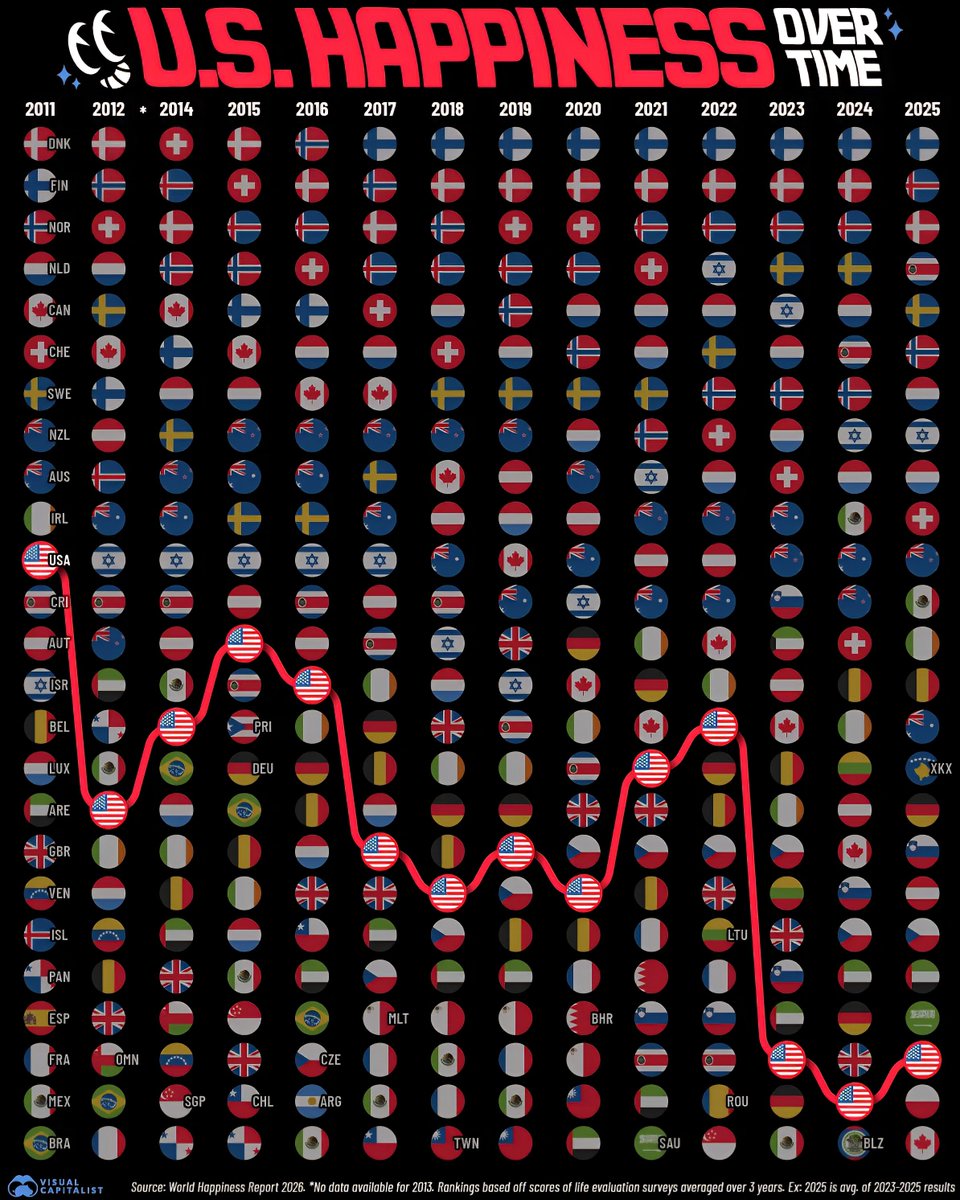
Steady Decline in Happiness Rankings Since 2023
America’s happiness ranking has seen a significant decline over the past few years. From a high of 11th in 2011, the nation gradually slid down the global ladder, reaching 23rd in both 2023 and 2024. This downward trend continued into 2025, with the US ranking at 23rd once again. Experts are analyzing various factors behind this decline, including social, economic, and political shifts.
2023-2025: A Stark Drop in Happiness
A sharp decline was evident starting in 2023, when the country fell from 15th in 2022 to 23rd. The subsequent years saw little recovery, with 2024 maintaining the same spot before a marginal improvement for 2025. This pattern suggests persistent issues affecting national well-being, prompting calls for policy reforms and societal introspection.
Fluctuations in Early 2010s: The Rise and Fall
Between 2011 and 2017, the US’s happiness ranks fluctuated, with minor ups and downs. The peak was in 2011 at 11th place, reflecting a relatively optimistic period. However, by 2017, the rankings declined to 18th, indicating a gradual decline over several years. Factors during these years included economic recovery post-recession, political polarization, and evolving social dynamics.
Dip During the COVID-19 Pandemic
The years 2020 and 2021, – marked by the COVID-19 pandemic – saw the US’s happiness ranking drop to its lowest points in the decade, at 19th and 16th respectively. The global crisis had profound effects on mental health, social cohesion, and economic stability, which became evident in these rankings. Despite efforts to recover, the subsequent years continued to show a struggle toward returning to higher happiness levels.
Persistent Challenges in American Well-being
Though the US has traditionally ranked high in global happiness indexes, recent years have highlighted deep-rooted challenges:
- Economic disparity and inflation affecting daily life
- Political polarization hindering social unity
- Mental health crises exacerbated by pandemic fallout
- Climate change and environmental concerns impacting overall well-being
The Role of Policy and Societal Efforts
While rankings provide a broad overview, the focus now turns to what can be done. Initiatives aimed at improving mental health, addressing economic inequality, and fostering community resilience are gaining momentum. Experts emphasize that sustainable change will require comprehensive policy reforms and community-based programs.
Public Sentiment and Future Outlook
Public sentiment remains mixed. Many Americans express concern over the nation’s direction but also hope for positive change through grassroots efforts and leadership initiatives. The coming years will likely be crucial in reversing this decline, with potential for growth if priorities shift toward holistic well-being.
Final Thoughts
America’s happiness trajectory over the past decade underscores a complex interplay of societal factors. With rankings slipping for three consecutive years, there’s an urgent need to prioritize mental health, economic stability, and social cohesion to restore national happiness levels. As policymakers and communities collaborate, the hope is to see a resurgence in American well-being in the years ahead.
 ChatGPT
 Perplexity
 Gemini AI
 Grok AI