Select Language:
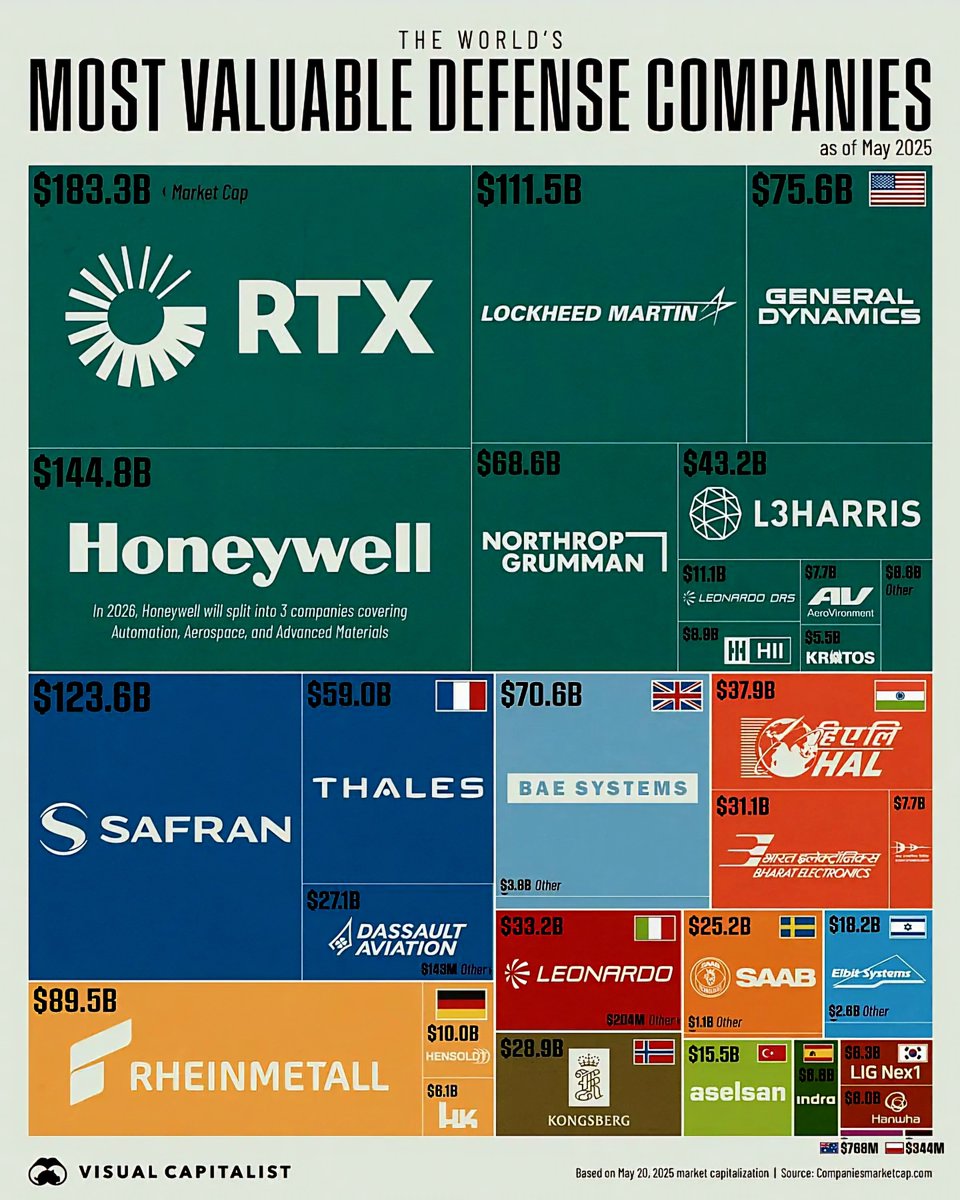
The 2025 List of the World’s Most Valuable Defense Companies: A Closer Look
- United States Dominates the Defense Industry
The defense sector continues to be a battlefield of innovation and geopolitical influence. As of May 2025, American companies lead the pack with significant market caps, highlighting their ongoing dominance in the global defense landscape.
- Raytheon Technologies (RTX): A $183.27 Billion Powerhouse
Holding the top spot, Raytheon Technologies (RTX) remains the most valuable defense company in the world. With an impressive valuation of over $183 billion, RTX continues to spearhead advancements in missile systems, aerospace, and cybersecurity solutions. Its extensive portfolio supports U.S. and allied military operations worldwide.
- Honeywell: Closely Following at $144.77 Billion
Honeywell International stands as a close contender, valued at approximately $144.77 billion. Known for its systems integration, avionics, and defense technologies, Honeywell remains a key player for the U.S. military and global defense contracts.
- Lockheed Martin: The Iconic Defense Giant
Lockheed Martin maintains its position as a defense and aerospace giant, with a valuation of over $111 billion. Its renowned products, such as the F-35 fighter jet and missile defense systems, continue to define the cutting edge of military innovation.
- North American Companies Continue to Lead
Other major U.S.-based firms include General Dynamics ($75.57B), Northrop Grumman ($68.60B), and L3Harris Technologies ($43.15B), emphasizing America’s strategic investment in defense infrastructure.
- European Powerhouses: Safran and BAE Systems
In Europe, France’s Safran ($123.61B) and the United Kingdom’s BAE Systems ($70.56B) dominate regional defense markets. Safran specializes in aerospace propulsion and security, while BAE Systems remains integral to European NATO defense initiatives.
- German and French Innovators
Germany’s Rheinmetall ($89.52B) is renowned for its armored vehicles and munitions, whereas France’s Dassault Aviation ($27.11B) leads in military aircraft manufacturing. These companies reflect Europe’s significant stake in modern warfare technology.
- Asian Military Industry Rising
India’s Hindustan Aeronautics (HAL) with a valuation of $37.94 billion highlights Asia’s expanding defense industry. Leonardo from Italy ($33.18B) and Bharat Electronics ($31.10B) also have growing footprints, underlining regional efforts to achieve self-reliance.
- Other Notable Players
Sweden’s Saab AB ($25.22B), Israel’s Elbit Systems ($18.20B), and Turkey’s Aselsan ($15.54B) show how regional firms are becoming increasingly influential, specializing in areas like electronics, surveillance, and integrated defense systems.
- Emerging Countries Making Strides
Korea’s LIG Nex1 ($6.34B) and Hanwha Systems ($6.01B) represent East Asia’s burgeoning defense sectors, investing heavily in missile technology, naval systems, and advanced weaponry.
- Smaller but Strategic
Companies such as Mercury Systems ($2.87B), V2X ($1.53B), and DroneShield ($0.68B) reflect niche markets focusing on cybersecurity, unmanned systems, and drone defense solutions that are becoming crucial in modern warfare.
- Global Impact of Defense Spending
The diversification in market caps demonstrates national priorities and technological capabilities. Countries with robust defense industries tend to invest heavily in R&D, aiming for technological superiority on the battlefield.
Key Takeaways:
- The United States maintains an undeniable lead with numerous multibillion-dollar firms shaping global military readiness.
- European companies, especially from France and the UK, continue to innovate, pushing the boundaries of aerospace and defense technology.
- Asian firms are rapidly evolving, aiming for independence and superior military capabilities.
- Smaller companies are emerging as vital players, especially in cybersecurity, unmanned systems, and specialized weaponry.
Conclusion
The defense industry in 2025 is characterized by a mix of established giants and rising regional players. Innovation, technological advancements, and geopolitical shifts dictate the ongoing transformations. Countries continue investing heavily in their defense sectors to safeguard interests and maintain strategic dominance, making this industry a critical indicator of global power dynamics.
Source: Companies Market Cap – May 2025
 ChatGPT
 Perplexity
 Gemini AI
 Grok AI