Select Language:
1. Russia Dominates the World Stage with Unmatched Reserves
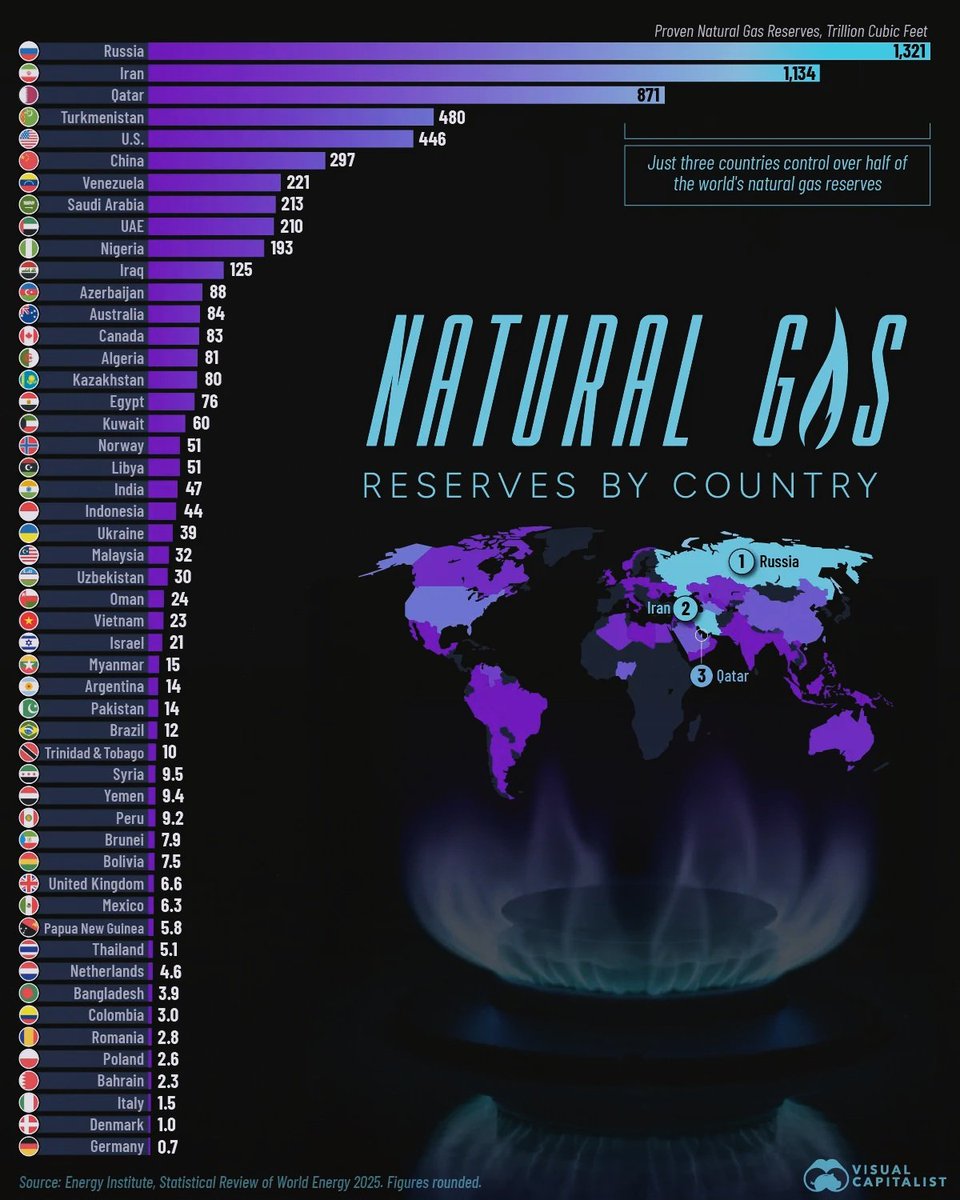
Russia holds the largest natural gas reserves globally, boasting an astonishing 1,321 trillion cubic feet. Its extensive reserves have solidified its status as a key player in the global energy sector, enabling it to influence international markets significantly. Russia’s vast natural resource wealth underpins its energy exports, impacting everything from geopolitics to global supply chains.
2. Iran Follows Closely Behind with Over a Trillion Cubic Feet
Iran’s proven reserves stand at 1,134 trillion cubic feet, making it the second-largest holder. Despite international sanctions and regional tensions, Iran remains a critical energy supplier, with its abundant reserves representing a strategic asset. The country’s focus on expanding infrastructure aims to boost production and meet both domestic and international demands.
3. Qatar: A Tiny Nation with Massive Reserves
Qatar, a small but wealthy Gulf nation, commands 871 trillion cubic feet in natural gas reserves. Known for its leading role in the liquefied natural gas (LNG) industry, Qatar leverages its reserves to bolster its economy and supply global markets. Its strategic investments in LNG infrastructure continue to enhance its prominence on the world stage.
4. Turkmenistan and the United States: Significant Yet Differing Reserves
Turkmenistan holds a noteworthy 480 trillion cubic feet, primarily contributing to regional energy dynamics in Central Asia. Meanwhile, the United States has accumulated 446 trillion cubic feet, thanks to extensive domestic shale gas development. The U.S. has emerged as a major exporter, influencing global energy geopolitics.
5. China and Venezuela: Emerging Giants
China has proven reserves totaling 297 trillion cubic feet, reflecting its goal to diversify energy sources. Although it consumes a considerable portion domestically, China is increasing investment in exploration and infrastructure. Venezuela, with 221 trillion cubic feet, possesses vast reserves that have been impacted by political and economic instability, yet remain a vital part of the global supply.
6. The Gulf Countries’ Contributions: Saudi Arabia and UAE
Saudi Arabia holds 213 trillion cubic feet, while the UAE has 210 trillion cubic feet in reserves. Both nations are shifting their focus toward expanding their natural gas sectors to meet growing domestic energy needs and support economic diversification away from oil dependence.
7. Nigeria and Iraq: Major Reserves in Africa and the Middle East
Nigeria’s reserves are estimated at 193 trillion cubic feet, positioning it as a significant African energy producer. Iraq follows with 125 trillion cubic feet, playing a vital role in regional energy stability amidst ongoing geopolitical challenges. Both countries are investing in infrastructure to increase their extraction capacities.
8. Smaller but Strategic Reserves in the Caucasus and Oceania
Azerbaijan (88 trillion cubic feet), Australia (84 trillion), and Canada (83 trillion) possess substantial reserves that not only serve their domestic markets but also help diversify global supply sources. Their strategic locations make them influential players in regional energy security.
9. North African and Middle Eastern Nations: Egypt, Kuwait, and Libya
Egypt’s reserves stand at 76 trillion cubic feet, serving as a regional energy hub. Kuwait and Libya hold 60 and 51 trillion cubic feet respectively. These nations are actively exploring expansion projects as regional demand increases, with Egypt seeking to become a key energy corridor.
10. The Emerging Markets and Future Potential
India (47 trillion), Indonesia (44 trillion), and Ukraine (39 trillion) are notable emerging markets with significant reserves. While India and Indonesia focus on increasing domestic production, Ukraine’s reserves could play a critical role in European energy security amidst ongoing geopolitical tensions.
This comprehensive overview highlights the uneven distribution of natural gas resources worldwide, shaping the geopolitical landscape and energy policies. As nations continue to strategize for energy independence and environmental challenges, these reserves will remain central to global economic stability in 2025 and beyond.
 ChatGPT
 Perplexity
 Gemini AI
 Grok AI