Select Language:
Countries Leading the Way in Domestic Food Production in 2025
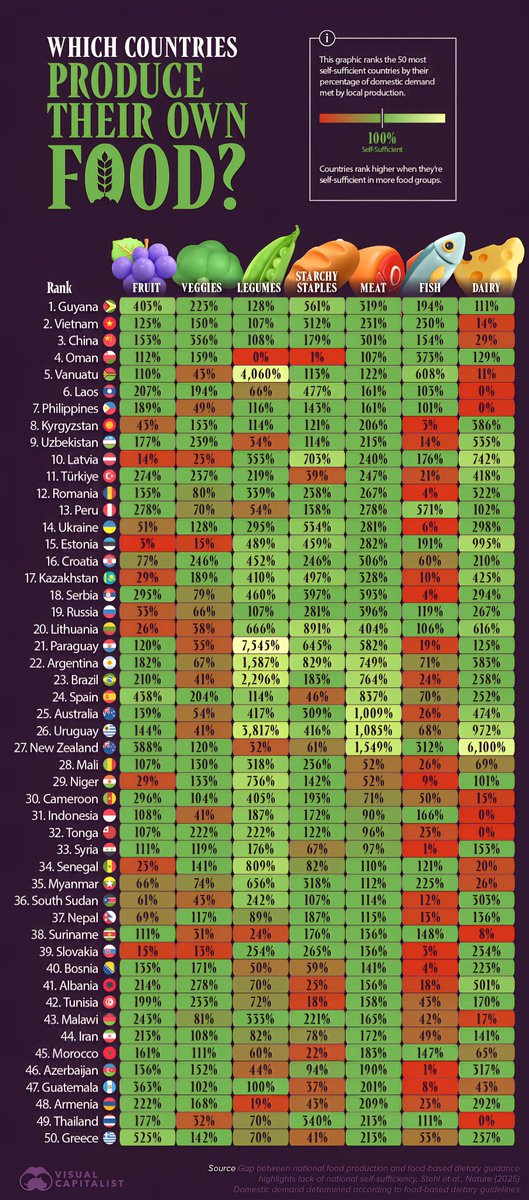
1. Guyana: The Sole Fully Self-Sufficient Nation
In 2025, Guyana stands out as the only nation worldwide that manages to produce enough food within its borders to meet the needs across all major food categories, without relying on imports. This achievement underscores the country’s robust agricultural sector and strategic food policies. From fruits and vegetables to meats and dairy, Guyana’s farms and fisheries sustain its population entirely from domestic sources.
2. China and Vietnam: Close but Not Complete
China and Vietnam come remarkably close to self-sufficiency, covering six of the seven essential food groups. These countries have made significant investments in their agriculture and aquaculture industries, allowing them to produce most of their required food. However, they still depend on imports to fill specific gaps, often in niche or premium markets, or for certain products not suitable for domestic farming.
3. The Seven Core Food Groups Defined
To clarify the scope of self-sufficiency, the Food and Agriculture Organization (FAO) recognizes seven primary food groups:
- Fruits
- Vegetables
- Legumes
- Starchy Staples (such as rice, wheat, maize)
- Meat (including beef, pork, poultry)
- Fish (marine and freshwater species)
- Dairy (milk, cheese, yogurt)
Achieving self-sufficiency across all these categories is an impressive feat, requiring a balanced agricultural ecosystem and significant investment in production infrastructure.
4. Challenges in Achieving Global Self-Sufficiency
While Guyana’s success provides a model, most countries face hurdles in producing all their food needs domestically. Factors such as climate diversity, land availability, water resources, technological access, and socio-economic elements influence a nation’s ability to become fully self-sustaining. Moreover, some crops or livestock require specific growing conditions that are not universally available.
5. The Impact of Self-Sufficiency on Food Security
Countries capable of producing their own food enjoy a heightened sense of food security. They are less vulnerable to global market fluctuations, trade restrictions, and geopolitical tensions. Guyana’s example highlights how investing in local agriculture can lead to national resilience and economic stability.
6. Future Prospects: Can More Countries Follow Suit?
While Guyana remains unique, there are pathways for others to increase food independence. Sustainable farming practices, technological advancements, and policy support are critical. Countries with diverse climates and rich natural resources may, over time, expand their self-sufficient food production capacities, reducing reliance on imports.
7. The Role of Global Cooperation
Despite the emphasis on self-sufficiency, international trade remains vital for a balanced and diverse food supply. Countries can benefit from global cooperation, sharing innovations, and trading surplus commodities to ensure nutritional needs are met efficiently worldwide.
By understanding these dynamics, nations can better strategize to enhance food security and reduce vulnerabilities in an increasingly interconnected world. As 2025 unfolds, Guyana’s pioneering status serves as both an inspiration and a benchmark for agricultural self-reliance.
 ChatGPT
 Perplexity
 Gemini AI
 Grok AI