Select Language:
2026 Global IQ Rankings: How Asian Countries Are Leading the Way in Intelligence
-
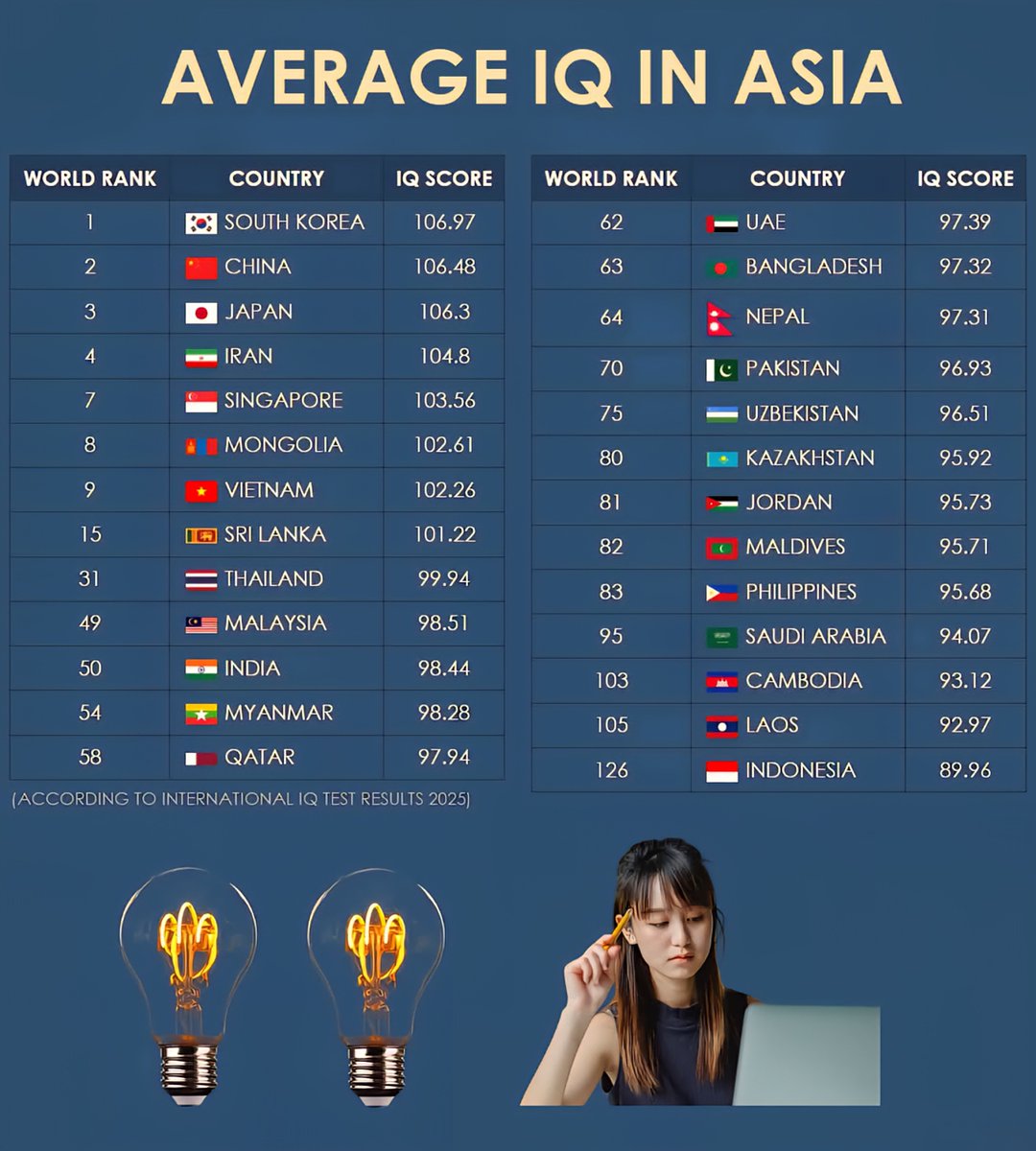
South Korea Takes the Lead with the Highest Average IQ in Asia
South Korea remains at the top of the Asian IQ rankings with an impressive average score of 106.97. Known globally for its advanced education system, technological innovation, and high literacy rates, the country’s focus on STEM education and rigorous academic standards continue to foster high cognitive abilities among its population. -
China Continues Its Steady Rise in Brain Power
Trailing just behind South Korea, China boasts an average IQ of 106.48. Over recent years, China’s investments in education infrastructure, increased access to higher education, and emphasis on science and technology have contributed to this upward trend. Major urban centers like Beijing and Shanghai are often highlighted as hubs of innovation and intellectual development.ADVERTISEMENT -
Japan Maintains Its Position as an Intellectual Powerhouse
With an average IQ of 106.30, Japan remains a key player in intellectual achievement within Asia. The country’s dedication to quality education, innovative research, and technological advancements have cemented its reputation as a nation with sharp cognitive skills. Japan’s education system consistently ranks among the top globally. -
Iran Shows a Remarkable Increase in Average IQ
Iran’s average IQ of 104.80 highlights remarkable progress in its educational infrastructure and scientific research. Enhanced access to quality education and a growing emphasis on scientific development have contributed to this rise, positioning Iran as a significant knowledge hub in the Middle East. -
Singapore’s Slight Edge Over Mongolia and Vietnam
Singapore has maintained an impressive average IQ of 103.56, reflecting its status as a global financial and technological leader, backed by a rigorous education system. Mongolia and Vietnam follow with averages of 102.61 and 102.26 respectively, showcasing the rapid development of their educational frameworks and cognitive skills. -
South and Southeast Asian Emerging Markets
Sri Lanka is notable with an average IQ of 101.22, while Thailand, Malaysia, and India present averages of 99.94, 98.51, and 98.44 respectfully. These numbers highlight significant strides in educational access and quality, although disparities still exist within these nations. -
Myanmar and Gulf Countries Pursue Cognitive Progress
Myanmar’s average IQ of 98.28 indicates ongoing development, aligned with expanding educational opportunities. Gulf nations like Qatar (97.94) and the UAE (97.39) are also making headway by investing heavily in high-tech industries and education systems aimed at boosting intellectual capacity. -
South Asian and Central Asian IQ Levels
Bangladesh (97.32), Nepal (97.31), and Pakistan (96.93) trail closely, reflecting diverse educational landscapes. Central Asian countries like Uzbekistan (96.51) and Kazakhstan (95.92) continue efforts to improve literacy and cognitive development through targeted policies. -
Middle East and Southeast Asia Cover New Ground
Jordan (95.73), Maldives (95.71), and the Philippines (95.68) are stepping into the world stage with consistent gains. Notably, countries like Saudi Arabia (94.07), Cambodia (93.12), and Laos (92.97) see these figures as starting points for further development. -
Indonesia Faces Challenges with Lower Average IQ
Indonesia’s average IQ of 89.96 stands out as the lowest among major Asian countries. Factors such as educational inequalities, economic disparities, and regional differences contribute to this figure. Significant investments and reforms are underway to enhance learning outcomes and cognitive skills across the archipelago.
Conclusion
Asia’s diverse nations continue to showcase varied levels of average intelligence, heavily influenced by investments in education, science, and infrastructure. Countries like South Korea, China, and Japan consistently excel, demonstrating the crucial role that quality education plays in shaping cognitive capabilities. Meanwhile, many emerging economies are rapidly closing the gap thanks to ongoing reforms and increasing access to learning opportunities.
As nations strategize for future growth, improving education remains at the core of enhancing cognitive skills and fostering a more innovative and competitive global community. The year 2026 reveals promising trends of progress and highlights the importance of continuous investment in human capital across Asia.
Source: International IQ Test, data compiled January 1, 2026, based on 1,212,714 test takers worldwide.
 ChatGPT
 Perplexity
 Gemini AI
 Grok AI