Select Language:
Top Countries with the Highest Average IQ in 2025: A Deep Dive
China Dominates the Global IQ Rankings
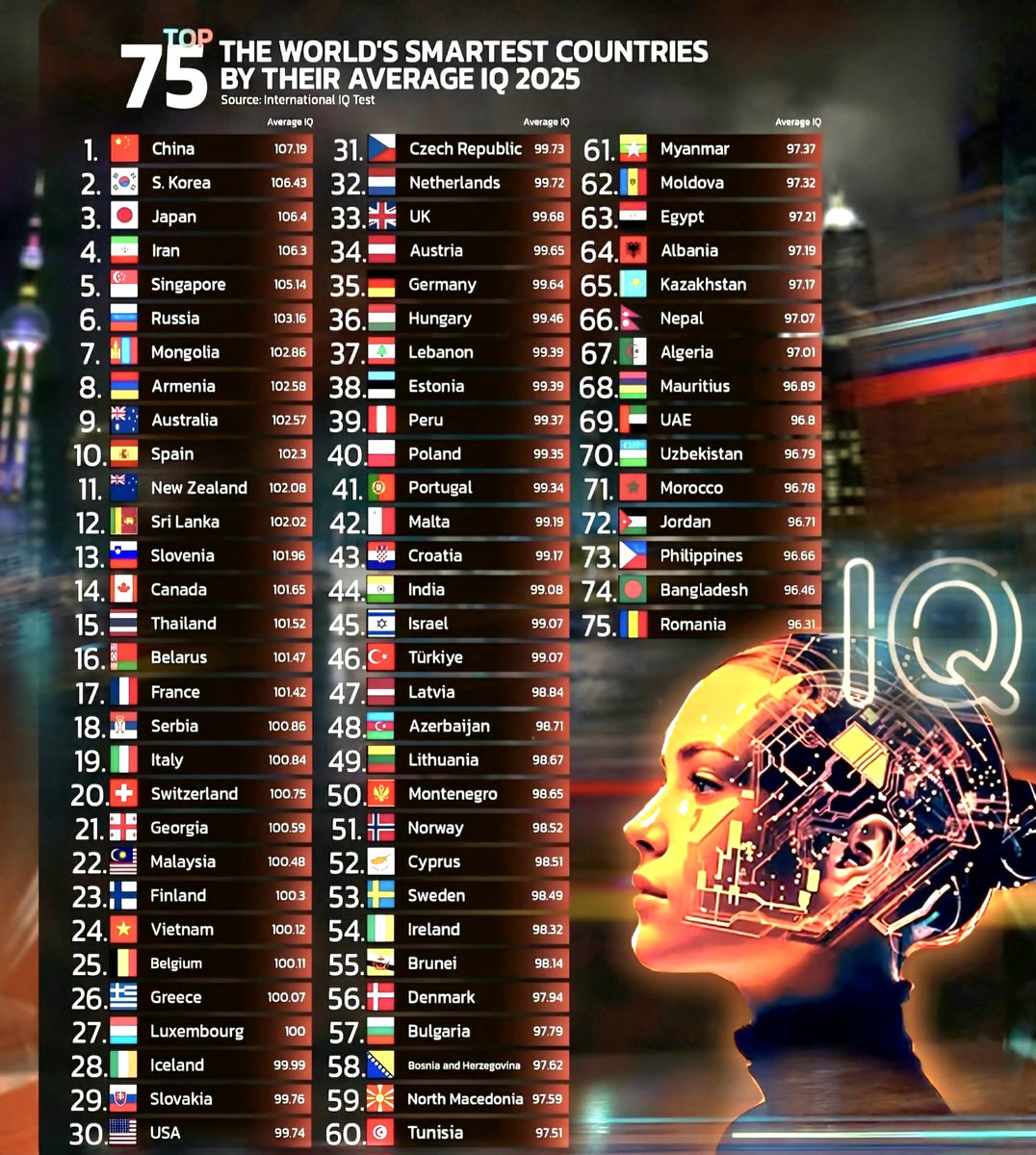
China continues to lead the world in average IQ scores as of 2025, with an impressive score of 107.19. This marks China’s sustained position at the top of international intelligence measures, reflecting its rapid advancements in education, technology, and economic growth. The country’s focus on STEM education and innovation plays a significant role in maintaining high cognitive performance levels among its population.
South Korea and Japan Hold Tight Reigns
South Korea and Japan place second and third respectively, with scores of 106.43 and 106.4. Both nations are renowned for their rigorous education systems and technological innovation. South Korea’s emphasis on education quality and Japan’s cultural dedication to academic excellence help boost average IQ scores, showcasing their continued leadership in cognitive development in Asia.
Iran and Singapore Make Notable Gains
Iran, with an IQ of 106.3, ranks fourth, exemplifying significant progress in intellectual growth by Middle Eastern standards, driven by education reforms and increased access to learning. Singapore maintains its solid position at sixth place with a score of 105.14, reflecting the city-state’s commitment to quality education and technological prowess.
Russia and Mongolia Lead in Eurasia
Russia’s IQ average of 103.16 ties it with Mongolia (102.86), representing substantial intelligence metrics from Eurasian countries. Russia’s robust higher education infrastructure and Mongolia’s rising emphasis on educational development contribute to these numbers, highlighting the importance of access and investment in cognitive growth.
Noteworthy European Performers
European countries continue to show strong cognitive performance. Spain and New Zealand score 102.3 and 102.08 respectively, showcasing the continent’s dedication to high-quality education systems. Slovenia, Canada, and Thailand follow closely behind, reflecting diverse regional investment in education and intellectual development.
The United States and Canada in the Mid-Tier
Interestingly, the United States ranks 30th with an average IQ of 99.74, just below Canada’s 101.65, which secures a spot in the top 15. These rankings suggest that while North America maintains high educational standards, other countries are closing the gap with innovative policies and investments.
Asian Countries Demonstrate Continuity
India, with an average IQ of 99.08, and Israel at 99.07, indicate ongoing educational challenges and opportunities within their regions. While significant advancements are evident, these scores reveal the importance of targeted programs to further raise cognitive abilities.
The Nordic Region’s Consistent Performance
Norway (98.52) and Sweden (98.49) continue to demonstrate the strength of Scandinavian education models, emphasizing personalized learning and technological integration, which sustain their positions in the global IQ rankings.
Emerging Nations Show Promise
Countries such as Bangladesh (96.46), Jordan (96.71), and the Philippines (96.66) are becoming more prominent in the rankings, fueled by governmental reforms, international collaborations, and increased access to quality education. These trends signify a broader global shift toward cognitive development.
Factors Shaping Future IQ Trends
While historical data and current educational investments suggest ongoing progress, a combination of technological disruption, socioeconomic factors, healthcare access, and policy initiatives will influence future IQ scores worldwide. Countries investing heavily in education reform and technology are likely to see continued upward trends.
In Summary
2025’s global IQ rankings reveal a clear picture: countries investing in education, technology, and healthcare tend to perform better in cognitive metrics. The rising numbers across various regions underscore a widening global landscape of intellectual growth, highlighting the pivotal role of policy, innovation, and social infrastructure. As nations strive to improve their populations’ cognitive capacities, the world moves closer to a more knowledge-driven and technologically advanced future.
Source: International IQ Test (January 1, 2025)
 ChatGPT
 Perplexity
 Gemini AI
 Grok AI