Select Language:
Top Nations Leading the World in Natural Resources
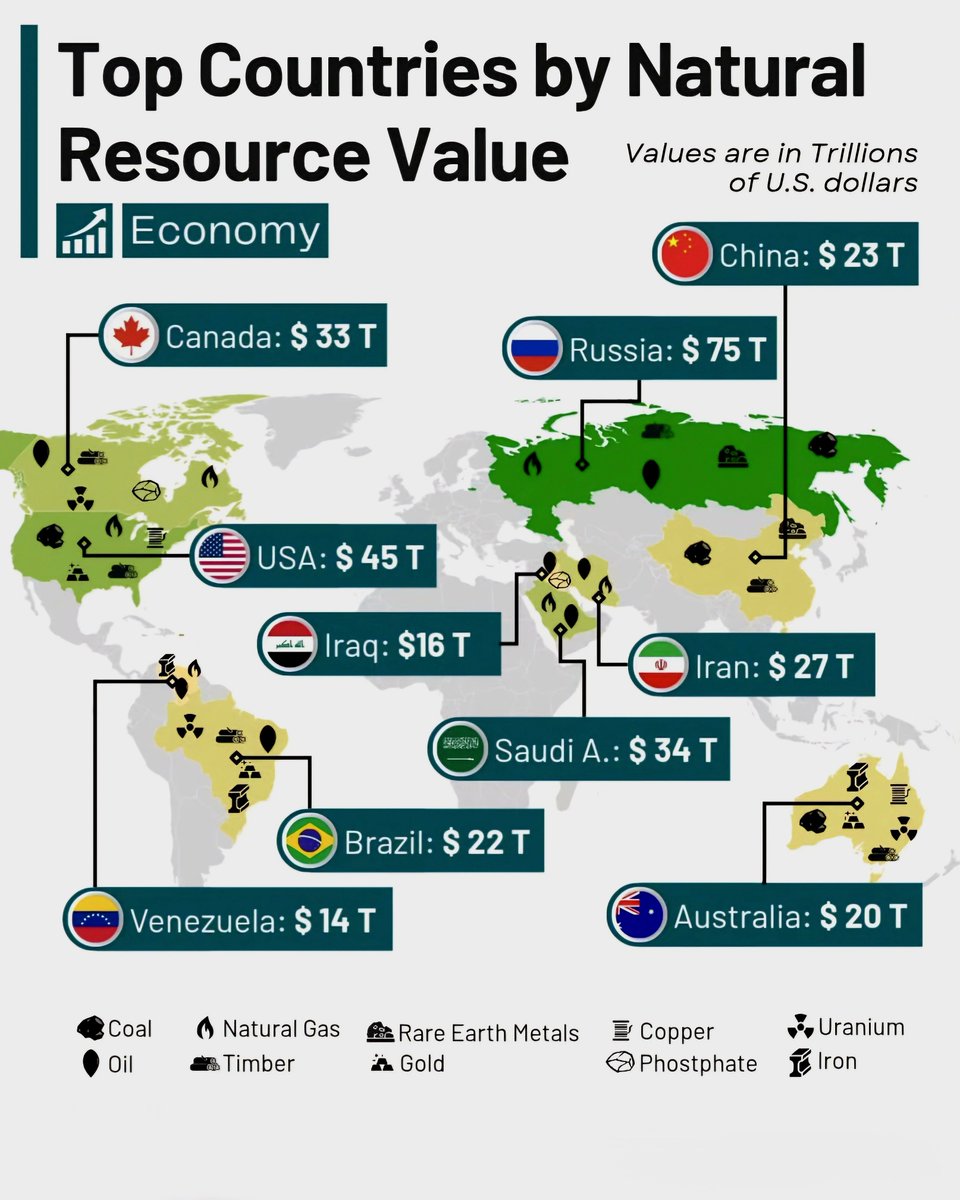
Russia Dominates with a $75 Trillion Resource Reserve
Russia remains the heavyweight champion of natural resources, boasting an estimated total value of approximately $75 trillion. Its vast reserves of oil, gas, minerals, and timber secure its place at the top of the global resource ranking. This wealth in natural assets plays a significant role in fueling Russia’s economy and strategic influence worldwide.
The United States Holds the Second Spot with Over $45 Trillion
The U.S. boasts a diverse array of natural resources valued at about $45 trillion. Rich in oil, natural gas, coal, and various minerals, America’s extensive natural bounty positions it as a leading resource powerhouse. This abundance not only supports domestic industries but also grants the country significant leverage in global markets.
Saudi Arabia’s Oil Reserves Valued at $34.4 Trillion
Saudi Arabia’s vast oil reserves are among the world’s largest, with an estimated resource value of around $34.4 trillion. This significant wealth has shaped the kingdom’s economic landscape and cemented its status as a global oil leader, influencing energy markets worldwide.
Canada and Iran Command Substantial Resource Wealth
Canada’s resource base, valued at approximately $33.2 trillion, spans oil sands, minerals, and timber, making it a pivotal player in global resource markets. Iran’s oil and gas reserves are estimated at $27.3 trillion, contributing substantially to its national wealth and regional influence.
Democratic Republic of Congo Sits Among the Top with $24 Trillion
The DRC’s mineral-rich lands—with vast deposits of cobalt, copper, and diamonds—hold an estimated $24 trillion in resources. Despite political and economic challenges, its untapped potential continues to attract global interest.
China and Brazil: Major Players in Natural Resources
China’s resource reserves are valued at roughly $23 trillion, supported by vast mineral deposits and energy reserves. Brazil, with an estimated $21.8 trillion in natural wealth, benefits from extensive forests, minerals, and offshore oil fields that bolster its economy.
Australia and Iraq’s Wealth in Resources
Australia, with nearly $20 trillion in resources, is a leader in minerals, coal, and energy exports. Iraq’s resource wealth, estimated at approximately $15.9 trillion, is primarily due to its considerable oil reserves, which are vital to its economy.
Highlighted Countries with Noteworthy Reserves
Venezuela ($14.3 trillion), Kazakhstan ($12 trillion), and Norway ($11 trillion) are crucial contributors in their regions, holding significant oil, gas, and mineral deposits. The United Arab Emirates and Nigeria follow closely, with reserves valued at $9 trillion and $8 trillion, respectively.
Emerging Resource Economies
Countries such as Chile, Mexico, and South Africa boast resource values exceeding $6 billion, significant enough to influence their economic growth trajectories. Argentina, Indonesia, and Peru also make the list, indicating their ongoing importance in global resource supply chains.
The Influence of Resources on Global Power Dynamics
Natural resource wealth significantly impacts geopolitical power and economic stability. Countries at the top of this list possess not only material wealth but also substantial influence over energy markets, commodity prices, and regional stability.
Data Sources and Variance in Estimates
These figures, compiled from numerous reputable sources—including the World Bank, IMF, U.S. Energy Information Administration, and others—are estimates based on current reserve data. Given the dynamic nature of discoveries and technological advancements, resource valuations continue to evolve.
This ranking underscores how natural resources serve as the backbone of national wealth, growth potential, and influence in the global arena. As nations continue to explore, exploit, and refine their resource sectors, these values are poised to shift, reflecting new discoveries and changing economic landscapes.
Note: The rankings and values are rounded estimates and may vary due to ongoing data updates and new resource discoveries.
 ChatGPT
 Perplexity
 Gemini AI
 Grok AI