Select Language:
Fascinating Geographical Coincidence: Countries Beginning with “I” Align in a Straight Line
1. A Unique Geographical Arrangement of “I” Countries
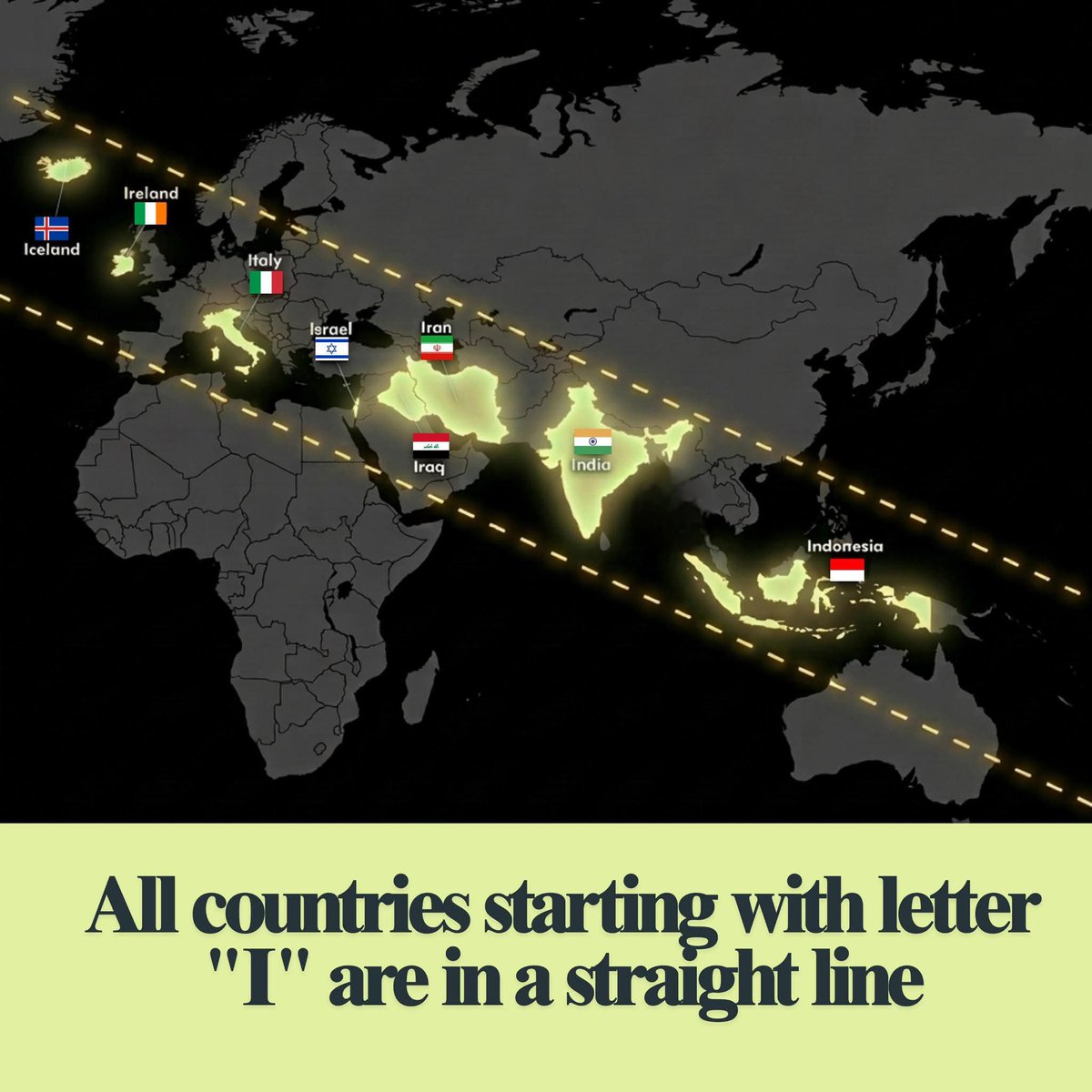
In 2025, geographers and world explorers have noticed an intriguing pattern concerning countries that start with the letter “I.” Surprisingly, every nation whose name begins with this letter is positioned along a remarkably straight geographical line. This rare alignment includes five countries, demonstrating how often the world surprises us with its natural and political intricacies.
2. Which Countries Are Part of This Line?
The countries that make up this unique line are Iceland, India, Indonesia, Iran, and Ireland. Despite spanning different continents and cultures, their longitudinal placement creates a straight path that stretches across parts of the Northern Hemisphere, from the icy terrains of Iceland down to the tropical islands of Indonesia.
3. The Geographical Significance
This alignment isn’t just a fun trivia fact; it offers insights into the continent and regional arrangements. For instance:
- Iceland is situated in the North Atlantic Ocean, representing Europe’s northwestern corner.
- India and Indonesia are among the most populous countries in Asia, with India located centrally in South Asia and Indonesia spanning across Southeast Asia’s archipelagic zones.
- Iran, straddling Asia and the Middle East, serves as a bridge between the Middle East and South Asia.
- Ireland, situated in Northwestern Europe, adds a Western European edge to this line.
This formation reveals how diverse regions—ranging from cold Iceland to tropical Indonesia—align along a common longitudinal thread, illustrating the unpredictable nature of world geography.
4. How Did This Alignment Come to Be?
Scientists and geographers have long studied the reasons for such arrangements. While it’s largely coincidental due to plate tectonics and historical settlement patterns, some attribute this specific straight-line alignment to the way the Earth’s crust has shifted over millions of years. The east-west distribution of these nations hints at underlying plate tectonic movements, yet the precise reasons remain complex and fascinating.
5. Implications for Climate and Culture
Although these countries are geographically aligned, their climates could hardly be more different:
- Iceland boasts glaciers, volcanoes, and a subarctic climate.
- India is known for its varied climate zones – from arid deserts to humid tropical regions.
- Indonesia, with its tropical rainforests and volcanic islands, is vastly different.
- Iran features arid deserts and mountainous terrain.
- Ireland has a temperate maritime climate with lush green landscapes.
This diversity underscores how geographical position alone doesn’t dictate climate or culture but provides a fascinating lens to compare human and natural environments across the world.
6. Future Exploration and Research
Leaders in geographical sciences are increasingly fascinated by such unusual patterns, leading to more detailed mapping and analysis. Whether this alignment impacts international relationships, climate research, or logistical considerations, it’s a reminder of the intricate tapestry that is Earth’s geography.
7. Human Curiosity and the Power of Random Patterns
This uncanny alignment fuels human curiosity and emphasizes how much we still have to learn about our planet. Such patterns, whether they arise by chance or by some underlying natural order, showcase the beauty and complexity of our world.
This extraordinary geographical coincidence demonstrates that even in a world riddled with diversity, patterns emerge that connect disparate regions in surprising ways. It’s a testament to the Earth’s dynamic history and the ongoing story of our planet’s continual evolution.
Note: The image highlights the linear alignment of these countries, visually emphasizing this interesting geographical phenomenon, capturing the imagination of explorers and map enthusiasts worldwide.
 ChatGPT
 Perplexity
 Gemini AI
 Grok AI