Select Language:
Top 40 Countries by GDP in 2025 (PPP)
1. United States:
Holding onto its position as the world’s economic powerhouse, the U.S. boasts a staggering gross domestic product (GDP) of over $35 trillion in PPP terms. The country’s dominant technology, finance, and healthcare sectors continue to propel its economic growth. Despite global uncertainties, the U.S. remains a key driver of innovation and consumption worldwide.
2. China:
Maintaining its status as a global economic giant, China’s GDP in 2025 surpasses $25 trillion PPP. Its rapid industrialization and investments in renewable energy, AI, and large-scale manufacturing ensure its position at the forefront of the world economy. The Belt and Road Initiative remains a crucial factor in expanding China’s economic influence worldwide.
3. India:
India secures its spot as the third-largest economy with a GDP nearing $13 trillion PPP. Its expanding middle class, technological innovations, and reforms in infrastructure and manufacturing sectors are fueling rapid economic expansion. The country’s booming digital economy and service sector are pivotal to its growth trajectory.
4. Japan:
Holding steady in the fourth position, Japan’s economy is valued at approximately $6.5 trillion PPP. Technological advancements, robotics, and automotive industries drive its economic engine, despite demographic challenges like an aging population. Japan remains a leader in innovation and high-tech manufacturing.
5. Germany:
Europe’s largest economy, Germany, boasts a GDP of roughly $5.5 trillion PPP. Its world-renowned automotive, engineering, and chemical industries sustain its economic strength. Continued focus on sustainability and renewable energy investments helps maintain its competitive edge.
6. Indonesia:
Climbing the rankings, Indonesia’s economy hits nearly $4.8 trillion PPP—reflecting its wealth of natural resources and youthful workforce. Infrastructure development and digital transformation initiatives are set to boost Indonesia’s position in the global economy further.
7. United Kingdom:
With a GDP around $4.3 trillion PPP, the UK remains a vital financial hub, especially in banking, insurance, and professional services. Post-Brexit trade recalibrations and innovations in fintech are aiding its economic resilience amid global shifts.
8. France:
France’s GDP stands close to $3.8 trillion PPP, with strengths in luxury, fashion, aerospace, and technology sectors. The country’s focus on sustainability and renewable energy is expected to drive future economic growth.
9. Brazil:
Brazil’s economy reaches approximately $3.4 trillion PPP, thanks to its vast natural resources, agricultural sector, and expanding renewable energy investments. Its emerging tech ecosystem is also gaining momentum.
10. Canada:
With a GDP nearing $3.2 trillion PPP, Canada benefits from abundant natural resources and a highly developed service sector. Economic stability and innovation in clean energy continue to promote sustained growth.
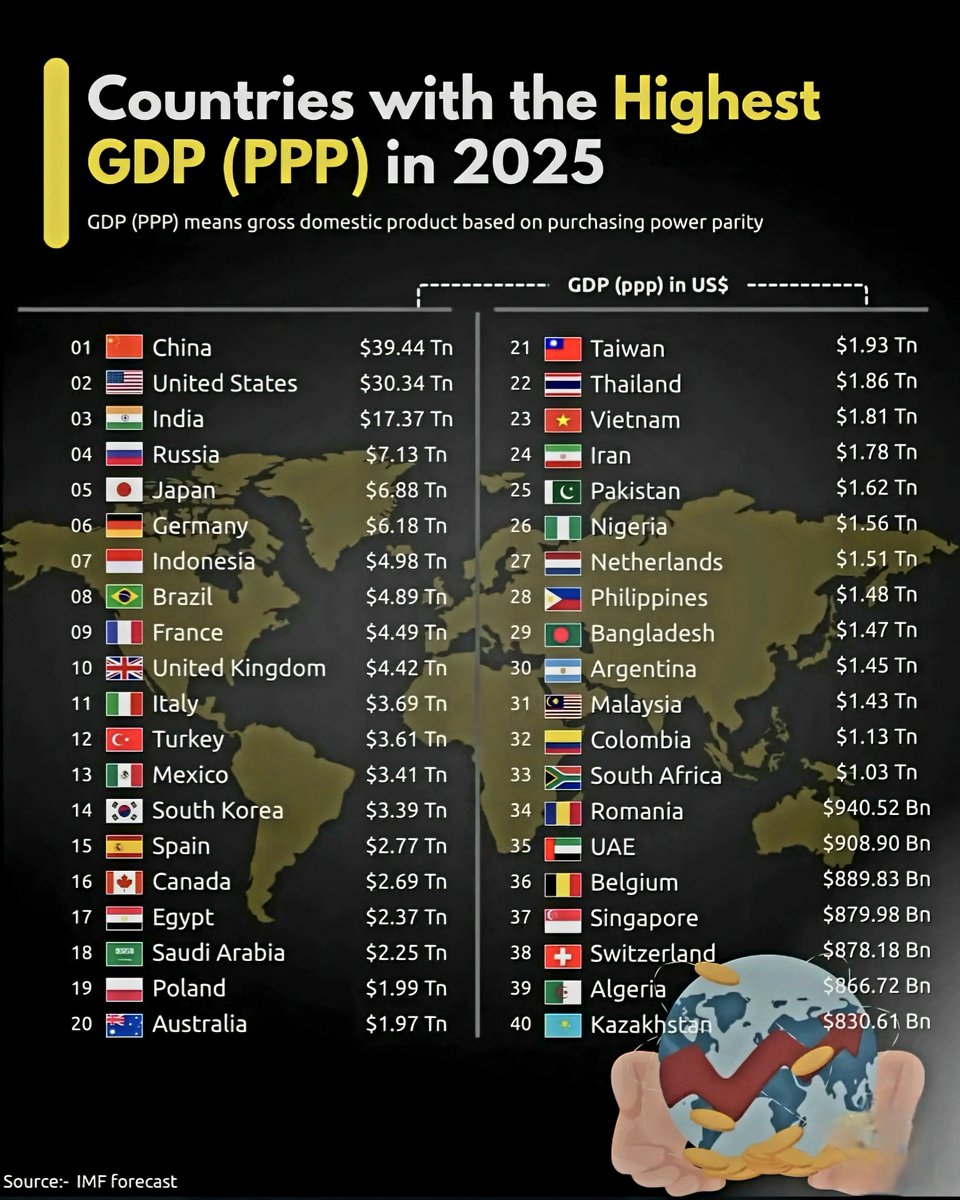
Note: The image below shows a visual representation of the world’s leading economies in 2025.
11-20: Notable Mentions in the Top 20
- Russia: Approximate GDP of $2.7 trillion PPP, bolstered by energy exports.
- South Korea: Around $2.4 trillion PPP, driven by tech and manufacturing.
- Italy: Close to $2.1 trillion PPP, with strong fashion, automotive, and aerospace sectors.
- Mexico: Over $2 trillion PPP, reflecting robust manufacturing and export growth.
- Australia: About $1.9 trillion PPP, benefiting from resource exports and financial services.
- Saudi Arabia: Approximate GDP of $1.8 trillion PPP, mainly supported by oil and energy sectors.
- Spain: Nearly $1.7 trillion PPP, with a vibrant tourism and automotive industry.
- South Africa: Around $1.4 trillion PPP, as the continent’s economic leader.
- Nigeria: Close to $1.3 trillion PPP, driven by oil, natural resources, and a burgeoning tech scene.
- Argentina: About $1.2 trillion PPP, with ongoing economic reforms and natural resource utilization.
21-30: Rising Economies and Regional Powers
- Turkey: An economy of approximately $1.1 trillion PPP, blending manufacturing, tourism, and energy.
- Vietnam: Around $1 trillion PPP, noted for its manufacturing boom and export strength.
- Poland: Near $900 billion PPP, with a resilient economy driven by industry and services.
- Thailand: About $850 billion PPP, boosted by tourism and exports.
- Egypt: Slightly over $800 billion PPP, as a regional economic hub.
- United Arab Emirates: Close to $750 billion PPP, with diversification beyond oil.
- Pakistan: roughly $700 billion PPP, led by agriculture and emerging industries.
- Malaysia: Over $680 billion PPP, focusing on electronics, manufacturing, and palm oil.
- Indonesia: Continuous growth, surpassing $650 billion PPP.
- Kenya: A rising African economy with notable progress in technology and agriculture sectors.
31-40: Emerging and Strategic Economies
- Colombia: Approaching $600 billion PPP, with diversified industries.
- Chile: Nearing $580 billion PPP, driven by mineral exports.
- Peru: Over $550 billion PPP, with strong mining and agricultural sectors.
- Bangladesh: Approaching $530 billion PPP, with rapid manufacturing growth.
- Vietnam: Climbing steadily, with GDP surpassing $520 billion PPP.
- UAE: With continued diversification, its economy exceeds $510 billion PPP.
- Qatar: About $490 billion PPP, mainly from liquefied natural gas.
- Ethiopia: Elevated growth to over $470 billion PPP, spotlighting Africa’s potential.
- Bangladesh: Rapid infrastructure development pushes its economy forward.
- Vietnam: Notable for its manufacturing export strength, maintaining its position in the top 40.
Summary:
The global economic landscape in 2025 reveals a diverse mix of established powerhouses and emerging economies. While traditional players like the United States, China, and India continue to lead, countries such as Indonesia, Nigeria, and Vietnam are rapidly climbing the ranks, driven by technological advancements, political reforms, and resource management. The evolving geopolitical and economic climate underscores the importance of innovation, sustainable growth, and regional cooperation for nations aspiring to enhance their global standing.
The future of global economics remains dynamic — with new leaders poised to emerge, innovation fueling growth, and sustainability shaping development trajectories worldwide.
 ChatGPT
 Perplexity
 Gemini AI
 Grok AI