Select Language:
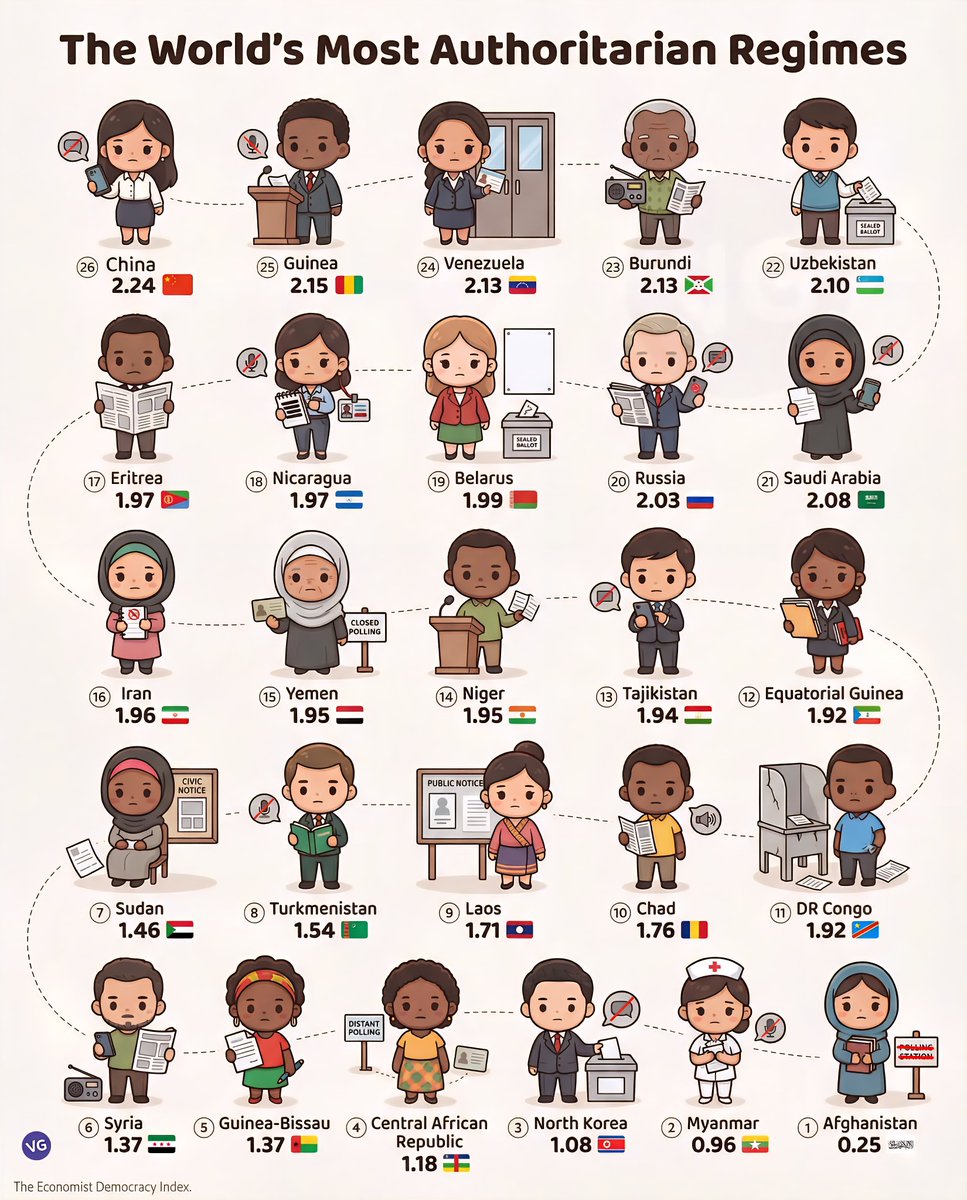
2025’s Top 26 Most Authoritarian Regimes Revealed
-
Afghanistan 🇦🇫
Since the Taliban regained control in 2021, Afghanistan has entrenched its reputation as one of the most authoritarian states. The regime enforces strict restrictions, especially on women and minorities, with limited space for dissent or free press. -
Myanmar 🇲🇲
After the military coup in 2021, Myanmar plunged into turmoil, with the military junta consolidating power through aggressive crackdowns on protesters and opposition groups, stifling democratic movements near completely. -
North Korea 🇰🇵
Long-standing in its oppressive rule, North Korea remains one of the most secretive and authoritarian countries, tightly controlling its population with extensive surveillance, propaganda, and a rigid command economy. -
Central African Republic 🇨🇫
Ongoing internal conflicts and weak governance have allowed authoritarian tendencies to flourish, with military leaders and rebel factions exerting significant control. -
Guinea-Bissau 🇬🇼
Political instability marked by frequent coups and military interventions keeps Guinea-Bissau firmly in the realm of authoritarian regimes. -
Syria 🇸🇾
The Assad regime’s brutal crackdown on dissent has maintained its grip over Syria amidst a complex civil war, consolidating authoritarian rule through violence and repression. -
Sudan 🇸🇩
Despite recent transitional promises, Sudan remains under the influence of military leadership controlling political power, limiting democratic reforms. -
Turkmenistan 🇹🇲
Possessing an almost hermetically sealed political environment, Turkmenistan enforces pervasive state control over every aspect of daily life, with no allowance for independent political activity. -
Laos 🇱🇦
One-party rule under the Lao People’s Revolutionary Party restricts political freedoms, with authoritarian policies suppressing opposition voices. -
Chad 🇹🇩
Persistent authoritarian governance under military and autocratic leadership has stifled political pluralism and freedom of expression. -
Democratic Republic of the Congo 🇨🇩
Weak state institutions, election irregularities, and political violence ensure the DRC remains under strict authoritarian influence. -
Equatorial Guinea 🇬🇶
One of Africa’s smallest countries, its leadership maintains power through tight control, legacy political corruption, and limited civil liberties. -
Tajikistan 🇹🇯
The government suppresses political activism, controlling the press and opposition to stay in power. -
Niger 🇳🇪
Military influence often overrides democratic processes, with authoritarian measures becoming more common. -
Yemen 🇾🇪
Ongoing civil conflict and foreign interference have resulted in fractured authority, with various factions exercising de facto control. -
Iran 🇮🇷
The Islamic Republic exerts tight control over political, social, and religious life, suppressing protests, dissent, and independent media. -
Eritrea 🇪🇷
Often called the “North Korea of Africa,” Eritrea’s government isolates its citizens with mandatory military service and severe restrictions on freedom. -
Nicaragua 🇳🇮
President Ortega’s government has dismantled democratic institutions, silencing opposition and controlling the media. -
Belarus 🇧🇾
Alexander Lukashenko’s nearly three-decade rule has been characterized by election fraud and a strong police state crackdown. -
Russia 🇷🇺
Under Vladimir Putin, Russia has intensified its authoritarian policies, limiting press freedoms and political opposition, with elections often criticized for irregularities. -
Saudi Arabia 🇸🇦
Despite recent reforms, the kingdom maintains autocratic control through royal decrees, with dissent silenced by strict laws and detention. -
Uzbekistan 🇺🇿
Near-total state oversight ensures political control, censorship, and suppression of dissent. -
Burundi 🇧🇮
Repeated electoral controversies and repression under President Nkurunziza’s long rule have entrenched authoritarian governance. -
Venezuela 🇻🇪
The Nicolás Maduro regime uses state institutions to suppress opposition, manipulate elections, and control the economy. -
Guinea 🇬🇳
Recent leadership disputes and violent protests highlight governance struggles and authoritarian tendencies. -
China 🇨🇳
A global superpower with a tightly controlled political system, the Chinese government maintains authority through censorship, mass surveillance, and repression of dissidents, especially in regions like Xinjiang and Hong Kong.
Source: The Economist Democracy Index via VG, 2025
Note: The landscape of authoritarian regimes continues to evolve, influenced by internal politics, economic pressures, and international relations.
 ChatGPT
 Perplexity
 Gemini AI
 Grok AI