Select Language:
How the World Expresses Laughter Online in 2025
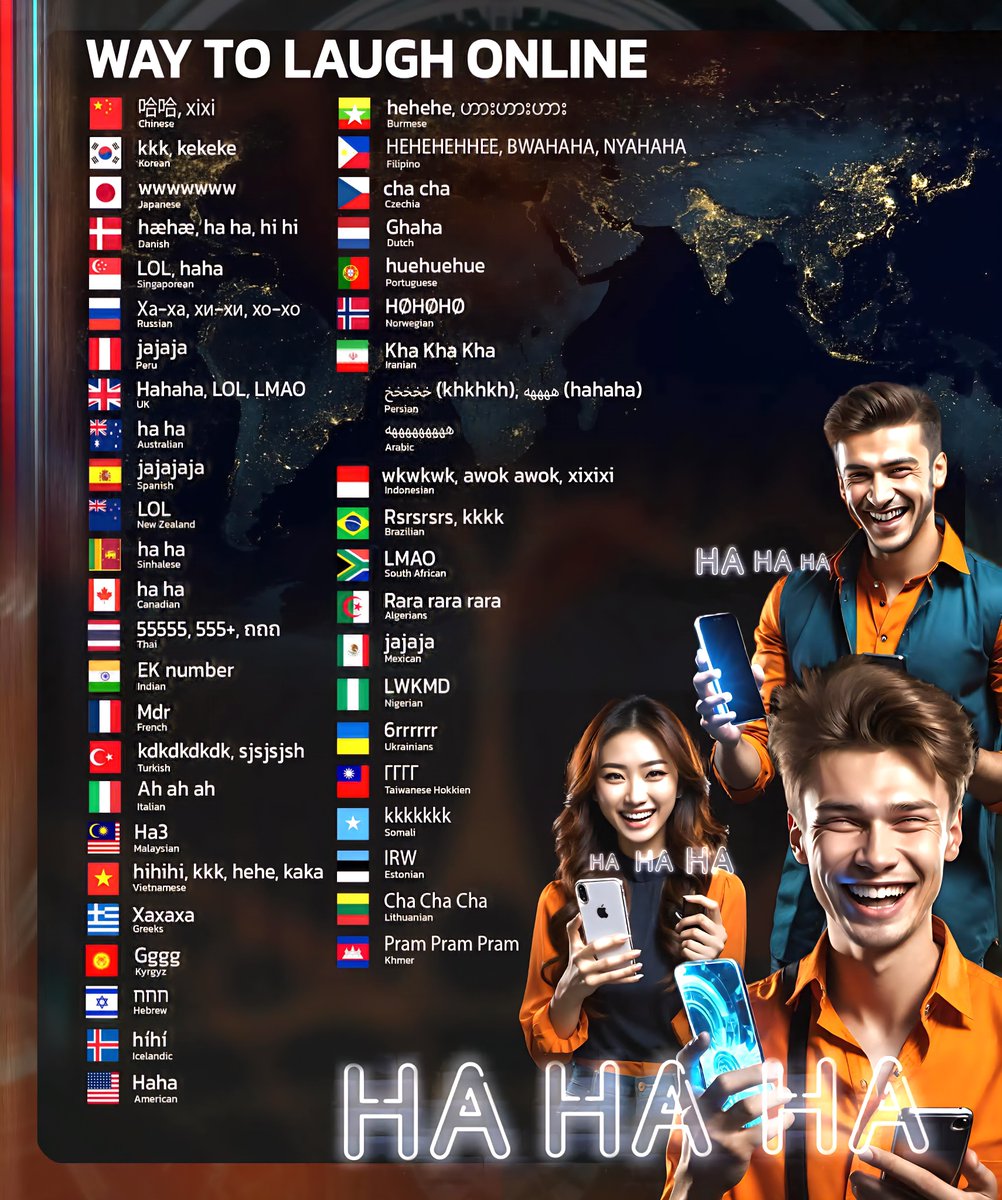
Laughter is universal, but the way it’s symbolized online varies widely across cultures and languages. As digital communication continues to evolve, so do the amusing and often quirky ways people worldwide showcase humor. Here’s a breakdown of international laughter expressions that dominate the internet scene in 2025:
China: The Popular “Xixi” and Its Variants
Chinese internet users often imitate laughter with “xixi,” a playful, almost childlike expression that resonates with the sound of giggles. It’s sometimes written as “哈哈” (hāhā) in characters, which means “ha ha,” but the phonetic “xixi” is more casual and commonly used among the younger crowd.
South Korea: “Kkk” and “Kekeke”
South Korean netizens favor “kkk,” short for “kkal kkall,” representing bursts of laughter similar to “haha.” Another favorite is “kekeke,” borrowed from online gaming culture, echoing the same laughter but with a more elongated burst.
Japan: The Unique “wwww”
Japanese users express laughter with “wwww,” which is the Romanized version of “warau,” meaning “to laugh.” The “w” is similar to writing “lol,” but the more “w”s, the more intense the laughter—sometimes stretching to “wwwwwww.”
Denmark and Scandinavian Countries: “Hæhæ” and Variations
Denmark’s audience often uses “hævhæv,” “ha ha,” or “hi hi,” straightforward and reminiscent of real laughter, expressing joy and amusement.
Singapore and Malaysia: Combining Text and Emoticons
Southeast Asian countries like Singapore and Malaysia often mix “LOL,” “haha,” or “Ha3,” reflecting casual, humorous online exchanges. Malaysians also add “Ha3” as a playful variation of “ha ha.”
Russia: Expressive “Ха-ха” and “Хи-хи”
Russian speakers tend to write “ха-ха” (kha-kha) or “хи-хи” (khi-khi), emphasizing their laughter through Cyrillic. These expressions are often used in lively online chats and social media comments.
Peru: The Endearing “Jajaja”
Peruvian internet users, like many Spanish speakers, favor “jajaja,” mimicking the sound of laughter in Spanish, akin to “hahaha” in English.
United Kingdom and Australia: The Classic “Hahaha” and “LOL”
British and Australian users stay true to the classic expressions “Hahaha,” “LOL,” and “LMAO,” representing genuine and lighthearted amusement across platforms.
Spain: “Jajajaja”
Spanish speakers embrace “jajajaja,” an extended form of “jaja,” widely used to signify laughter in online conversations.
New Zealand and Canada: Keep It Simple with “LOL” and “Ha Ha”
Users from New Zealand and Canada favor concise expressions like “LOL” or “ha ha,” reflecting relaxed scrolling and chatting styles.
Thailand: Playful “55555” and “555+”
In Thailand, the numbers “5” are pronounced “ha,” leading to the use of “55555” to represent laughter—similar to “hahaha”—with “+” signifying intensification.
India: The Cultural “Ek Number”
Indians often use the phrase “Ek Number,” meaning “top-notch” or “awesome,” sometimes humorously to indicate something laugh-worthy. Additionally, “Haha” and “lol” are common.
France: The Expressive “MDR”
French netizens use “MDR,” short for “mort de rire” (“dying of laughter”), to convey humor in text messages and comments.
Turkey: Playful “kdkdkd” and “sjsjsjsh”
Turkish online users often type repetitive consonants like “kdkdkd” or “sjsjsjsh,” creating a humorous, exaggerated impression of laughter.
Italy: The Rhythmic “Ah ah ah”
Italians extend their laughter with “ah ah ah,” often combined with emojis or expressions like “😂,” serving as a lively digital laugh track.
Vietnam and Other Asian Countries
Vietnamese users favor “hihihi,” “kkk,” “hehe,” or “kaka.” Similarly, Indonesians might use “wkwkwk,” “awok,” or “xixixi,” reflecting their vibrant online chatter.
Brazi and Africa: “Rsrsrs,” “Kkkk,” and “LMAO”
Brazilian users are known for “rsrsrs” and “kkk,” while South Africans stick with “LMAO,” showcasing their fun and spontaneous humor expression styles.
Middle Eastern and Persian Variations
In the Arab world, “هههههه” (hahaha in Arabic script) is prevalent. Persians use “خخخخ” (khkhkh) or “ههههه” (hahaha), echoing the laughter within their digital spaces.
Summary
Expressions of laughter online are as diverse as the cultures themselves, blending language, pronunciation, and digital habits to create a vibrant, global tapestry of humor. Whether it’s “xixi” in China, “kekeke” in Korea, or “hahaha” in Spain, the way people giggle behind screens remains uniquely captivating around the world.
Note: Variations in online laughter are constantly evolving, influenced by language, social trends, and technological shifts, ensuring that humor remains a universal connector.
 ChatGPT
 Perplexity
 Gemini AI
 Grok AI