
Select Language:
Astronomers leveraging NASA’s James Webb Space Telescope have uncovered a massive planet with an atmosphere abundant in methane, providing scientists a rare glimpse into a type of world that’s scarcely represented in our current catalog of known planets.
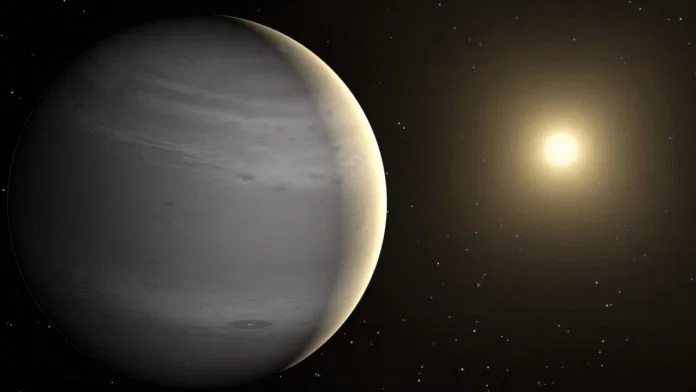
This planet, designated TOI-199b, is roughly the size of Saturn but maintains surprisingly mild temperatures similar to Earth’s, contrasting with most giant planets we’ve studied so far.
The discovery was published in The Astronomical Journal by researchers from Pennsylvania State University and NASA’s Jet Propulsion Laboratory.
Most known giant planets fall into two extreme categories. In our solar system, planets like Jupiter and Saturn are extremely cold because they orbit far from the sun. Conversely, astronomers have identified many “hot Jupiters,” planets that orbit very close to their host stars and can reach searing temperatures of thousands of degrees.
TOI-199b falls somewhere in between. It orbits its star once every 100 days and has a temperature around 175°F. While still warm for people, this is considerably cooler than most other exoplanets of similar size that scientists have observed.
Located over 330 light-years from Earth, TOI-199b is one of only a handful of known temperate gas giants. Even more notably, it’s the first of its kind to undergo detailed atmospheric analysis.
To study its atmosphere, scientists used a technique called transmission spectroscopy. When the planet transits in front of its star, some of the star’s light passes through the planet’s atmosphere before reaching the Webb telescope. Different gases absorb specific wavelengths of light, creating unique spectral signatures that reveal their chemical composition.
The team observed the system for approximately 20 hours, including a seven-hour transit period. By comparing the star’s baseline light with the filtered light passing through the atmosphere, they detected clear signs of methane.
The presence of methane in such a temperate giant planet aligns with existing predictions, reinforcing the idea that methane-rich atmospheres are common in these worlds. The observations also suggest that ammonia and carbon dioxide might be present, though further research is necessary to measure their quantities.
Studying planets like TOI-199b helps scientists better understand planetary formation and how atmospheres change over time. Although this planet isn’t suitable for life as we know it, analyzing its atmospheric properties could offer insights into broader planetary system processes, including those that shaped Earth.
This research also showcases the remarkable capabilities of the James Webb Space Telescope. Moving forward, astronomers aim to examine more temperate giant planets to see if TOI-199b is an exception or part of a larger population of worlds that we are just beginning to discover.
 ChatGPT
 Perplexity
 Gemini AI
 Grok AI