
Select Language:
Scientists at the University of Iowa have created a new material capable of extracting water directly from the air using only light. This breakthrough could help supply drinking water to arid regions where clean water sources are scarce.
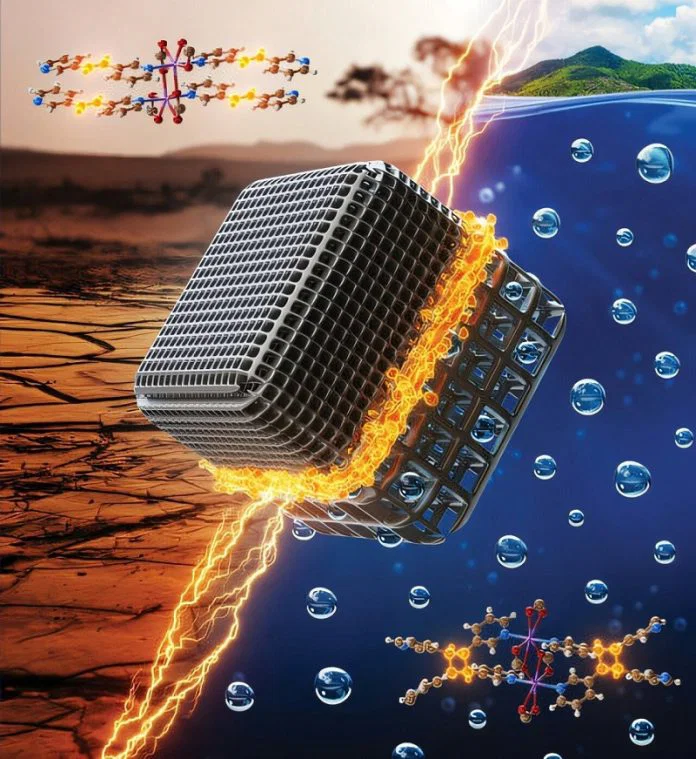
Published in the Journal of the American Chemical Society, the research details a crystal-like substance that responds to ultraviolet (UV) light by changing its shape. When exposed to UV rays, this material’s structure shifts, creating tiny internal pockets that trap water molecules from the surrounding atmosphere. The scientists describe it as resembling a vast collection of microscopic water bottles.
Leonard MacGillivray, one of the lead researchers, explains, “We’ve figured out a way to capture and store water solely through sunlight. The crystal structure can be transported and then released on demand.”
This innovative material belongs to a class called metal-organic frameworks, or MOFs. These substances are composed of metal atoms connected by organic molecules, forming three-dimensional frameworks full of small pores. For decades, scientists have studied MOFs because they can effectively trap gases, chemicals, and other substances within their tiny cavities.
Initially, the Iowa team faced challenges designing cavities suitable for water storage. Their original framework incorporated flexible molecular linkers, but the structure remained too dense. When they exposed the material to UV light, however, surprising results emerged. The light induced a chemical reaction that reconfigured the molecular linkers, which shifted from parallel lines to an X-shaped form. This reorganization created numerous small cavities throughout the structure.
X-ray analysis confirmed that water molecules had already entered these newly formed pockets. Each cavity can hold two water molecules, which collectively amount to about 5% of the material’s total weight when fully saturated.
The team suggests that water molecules likely migrate along the surface through hydrogen bonding before settling into the open cavities. Although the current version of the material only stores a modest amount of water, its self-assembling crystal structure means it could be produced in large quantities.
The researchers are now working to increase the material’s water capacity and plan to replace cadmium—a toxic metal used in the current framework—with safer alternatives. They describe this technology as “intelligent” because the water harvesting process is triggered by light, primarily sunlight, making it a potentially low-energy way to extract clean water from the atmosphere.
As climate change intensifies and water shortages threaten more communities globally, such advancements could become critical solutions in the future.
 ChatGPT
 Perplexity
 Gemini AI
 Grok AI