Select Language:
From Earth’s vantage point, we can only observe half of the sun at any given time. The other half—the far side—remains hidden from view, yet what happens there is still significant. Active solar phenomena developing on the far side can eventually rotate toward Earth, potentially sparking solar storms that could impact satellites, communication networks, and power grids.
Scientists have now devised an innovative approach to better understand what occurs on the sun’s unseen side. In a study published in Scientific Reports, researchers led by Amr Hamada demonstrated how to map not only the locations of active regions on the sun’s far side but also their magnetic structures.
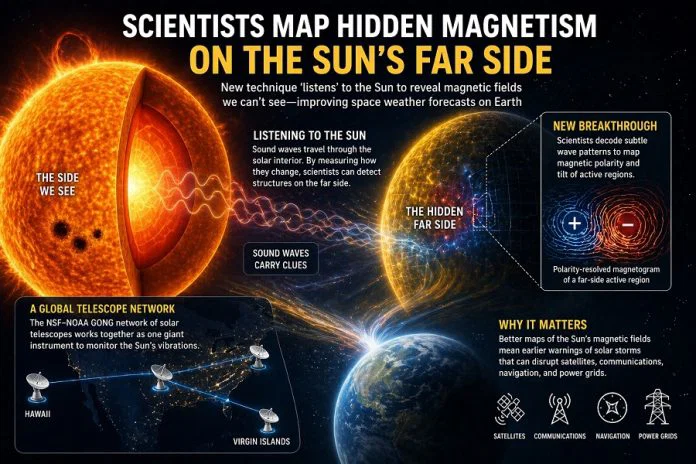
For years, helioseismology has been the primary technique used to study the sun’s hidden hemisphere. This method involves “listening” to sound waves that travel through the sun’s interior. These waves bounce within the sun’s layers, carrying clues about what lies beneath the surface. By analyzing these wave patterns, scientists can detect large areas of activity, like sunspots, even when they are not directly visible.
However, until recently, helioseismology couldn’t reveal an essential detail—magnetic polarity, which indicates the direction of magnetic fields. This information is crucial because magnetic polarity influences how solar activity unfolds. Different magnetic configurations can lead to either intense eruptions or relatively minor events, affecting how we predict solar behavior.
The breakthrough came from examining minute variations in the sound waves, known as phase shifts. The research team utilized data from the Global Oscillation Network Group, a global network of solar observatories that continuously monitor the sun. By studying these tiny changes, they gathered clues about the arrangement of magnetic fields in regions hidden from view.
This enabled them to estimate the magnetic polarity and orientation of active regions on the sun’s far side. Essentially, they created magnetic maps of areas that are normally beyond our visual reach—advancing our goal of developing a more comprehensive picture of the sun’s magnetic environment.
This progress has tangible benefits for space weather forecasting. Since the sun completes a rotation roughly every 27 days, regions on the far side can rotate into view and influence Earth shortly afterward. The earlier scientists can identify and analyze these active regions, the better they can predict space weather events and issue warnings.
Such warnings are increasingly critical in our tech-dependent world. Solar storms can damage satellites, disrupt GPS signals, interfere with communications, and even affect terrestrial power systems. Gaining a more complete understanding of the sun’s magnetic behavior could help mitigate these risks and protect our infrastructure.
Although we can’t directly observe the far side with telescopes, this research demonstrates that it’s not beyond reach. By analyzing the sun’s internal vibrations, scientists are uncovering hidden magnetic patterns that drive its most powerful activities. With ongoing advancements, this approach might eventually enable a continuous, full-map view of the sun’s magnetic field, including parts we can never directly see.
 ChatGPT
 Perplexity
 Gemini AI
 Grok AI