
Select Language:
Lithium has become an essential mineral worldwide because it’s a crucial component in rechargeable batteries powering electric vehicles, smartphones, laptops, and energy storage systems.
With the rising demand for batteries, the need for lithium continues to grow. Although countries like the U.S. and Australia possess significant lithium resources, much of the refining still occurs in China.
One reason is that extracting lithium from hard rock is currently costly, requires a lot of energy, and produces substantial waste.
Now, researchers at MIT and their partners have created a new method that could significantly transform lithium production. Their process extracts lithium from hard rock at low temperatures, almost eliminates waste, and could reduce costs by approximately 50% compared to traditional methods. This research was published in the journal Science.
Traditionally, extracting lithium from hard rock involves heating the rock above 1,000°C and then using chemicals to separate the lithium. This process consumes significant energy, and the leftover rock waste is typically discarded.
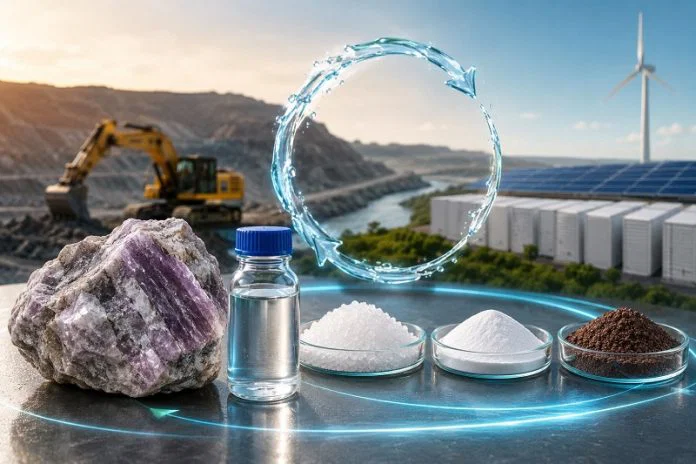
In contrast, the new approach uses a liquid mixture of water and ammonium fluoride to dissolve the rock at room temperature. This allows for the separation of the valuable minerals without high heat. The main lithium mineral, spodumene, mainly consists of lithium, aluminum, and silica. The researchers found ways to recover each component in useful forms: lithium as battery-grade lithium carbonate and lithium hydroxide, aluminum as smelter-grade material, and silica for cement production.
Since every major component is recovered and sold, waste is minimized. Interestingly, the idea for this process stemmed from a discovery made roughly 25 years ago. MIT professor Yet-Ming Chiang noticed that a glass-etching cream containing ammonium fluoride could dissolve glass. Because glass and spodumene both contain high silica content, he wondered if the same chemistry could break down lithium-bearing rock, leading to this innovative method.
The team further developed a way to recover and reuse the ammonium fluoride and water used in the process, establishing a closed-loop system that recycles key chemicals rather than discarding them.
They tested the method on 17 different spodumene samples from around the world, indicating broad applicability. Besides environmental advantages, this technology could bolster lithium production domestically in countries like the U.S. and Australia. Given the expected surge in demand over the coming decades, more efficient extraction techniques will be vital.
To commercialize their innovation, the researchers launched a startup called Rock Zero. They are now working to scale up the process and believe it could become one of the most affordable and sustainable methods for producing lithium for future batteries.
Source: KSR.
 ChatGPT
 Perplexity
 Gemini AI
 Grok AI