
Select Language:
A new discovery suggests that Neanderthals might have performed dental procedures nearly 60,000 years ago. Scientists analyzed an ancient molar found in Siberia’s Chagyrskaya Cave, revealing evidence that these early humans likely used sharp stone tools to drill into a painful cavity, making it the oldest known example of dental treatment.
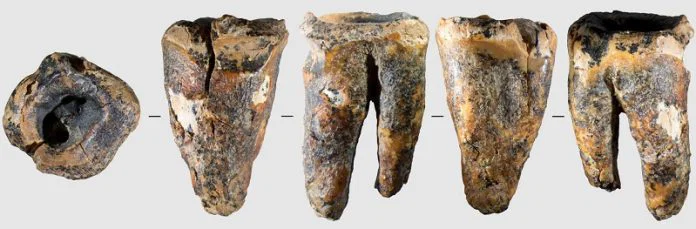
Published in PLOS One, the study was led by researcher Alisa Zubova from Russia’s Peter the Great Museum of Anthropology and Ethnography. The molar belonged to a Neanderthal who lived approximately 59,000 years ago. At its center, scientists identified a deep hole that extended into the pulp cavity—the soft tissue inside the tooth that contains nerves and blood vessels.
Initially, the shape of the hole puzzled researchers. It didn’t resemble typical tooth decay or natural damage. Under microscopic examination, they observed distinct scratches inside the cavity, indicating the hole was deliberately made rather than resulting from accidental damage.
To explore further, scientists performed experiments on modern human teeth using sharp stone points similar to tools recovered from the same cave. The patterns and grooves produced during these experiments closely matched the microscopic marks inside the Neanderthal molar.
The evidence suggests that the Neanderthal may have experienced a severe cavity or infection and used the stone tools to remove infected tissue, likely alleviating pain. Although such an invasive procedure would have been extremely painful, it could have provided lasting relief. The wear marks on the tooth also indicate the individual survived the treatment and continued to use the tooth afterward.
This finding highlights a surprising level of medical knowledge among Neanderthals. It shows they could identify sources of pain, understand how to treat them, and skillfully manipulate tools for medical procedures. Performing such work would have required patience and resilience from the patient.
While previous evidence has shown that Neanderthals used toothpicks and possibly medicinal plants, this is the first clear indication that they conducted direct dental interventions. The discovery redefines ideas about Neanderthal intelligence and everyday life, revealing that they may have possessed practical medical skills far earlier than previously thought.
Researchers conclude that this finding pushes back the history of dental treatment by more than 40,000 years and suggests that complex healthcare behaviors were not exclusive to modern humans.
 ChatGPT
 Perplexity
 Gemini AI
 Grok AI