
Select Language:
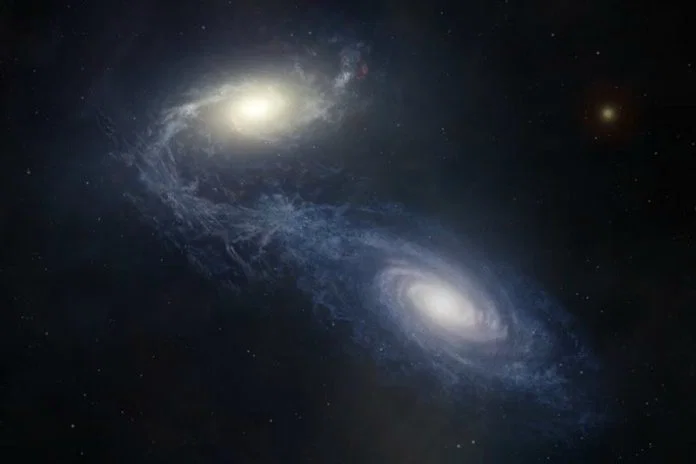
billions of years ago, a young spiral galaxy started forming in a densely populated area of the universe.
It pulled in gas and small companion galaxies, gradually creating the bright core and sweeping spiral arms that we observe today.
In a study published in March 2026, my colleagues and I analyzed this galaxy’s chemical signatures to piece together its detailed history.
Astronomers seek to understand how galaxies like our Milky Way originated, as these systems offer clues about how elements such as oxygen were produced and distributed across space over cosmic time.
Space archaeology
Similar to how archaeologists examine soil layers to uncover Earth’s natural history, we used slices of data about the galaxy’s chemical composition from different periods, combined with advanced models of galaxy development.
This approach enabled us to reconstruct how the galaxy formed and evolved over more than 12 billion years.
The galaxy, known as NGC 1365, is relatively close in cosmic terms and is oriented so that we see its spiral disk face-on. Using the du Pont telescope at Las Campanas Observatory in Chile, we mapped the distribution of oxygen in thousands of star-forming gas clouds.
We then compared our observations to about 20,000 simulated galaxy models and identified one that matches NGC 1365 remarkably well. We considered numerous factors, including the presence of heavy elements like oxygen, while matching the simulation to real data. The model allowed us to look back in time and predict how the galaxy grew through mergers and gas accretion.
Tracing heavy element formation
Heavy elements are created in stars and released during supernova explosions within galaxies. Over time, this process leaves behind a record that scientists can detect in the gas—much like archaeologists look for specific materials in soil layers.
Typically, the cores of galaxies tend to be richer in heavy elements, while the outer regions contain less. This pattern provides insights into when stars formed, gas movement, and the galaxy’s interaction history.
For NGC 1365, our findings suggest its core formed early and quickly accumulated oxygen. The outer regions developed more slowly. Over billions of years, the galaxy likely absorbed smaller dwarf galaxies, bringing in fresh gas and stars that contributed to building its spiral arms. Much of the gas in the outer edges probably arrived later in its evolution.
This work represents some of the first detailed “chemical archaeology” studies conducted outside our own Milky Way. By merging high-resolution observations with cutting-edge simulations, we’ve created a new method for studying the assembly of distant galaxies across cosmic history.
Remaining mysteries
While we can trace a general history of NGC 1365 using our models and observations, some details remain uncertain.
Different combinations of gas flows and galaxy mergers can produce similar chemical signatures, which makes it challenging to determine the exact past events. Additionally, it’s still unclear whether NGC 1365 is typical for large spiral galaxies or if it has a unique evolutionary path.
Key questions include: Do most spiral galaxies build their centers early and then slowly develop their outer disks? How much of a galaxy’s growth results from mergers versus gas inflow? And most intriguingly, how does NGC 1365’s history compare to that of our own Milky Way?
Written by Lisa Kewley, The Conversation
 ChatGPT
 Perplexity
 Gemini AI
 Grok AI