Select Language:
Under the policy of “early issuance, early utilization, and early effectiveness,” local governments across China have set a new record for bond issuance within the first four months of the year. During this period, approximately CNY 3.92 trillion (USD 576.3 billion) in local government bonds were issued, marking an 11% increase compared to the same period last year when CNY 3.54 trillion was issued.
This uptick indicates a proactive fiscal approach early in the year aimed at counteracting economic slowdown and bolstering steady growth, according to Zhong Ninghua, a professor at Tongji University’s School of Economics and Management. Experts anticipate that the trend of early bond issuance will carry on and reach its peak in the second quarter.
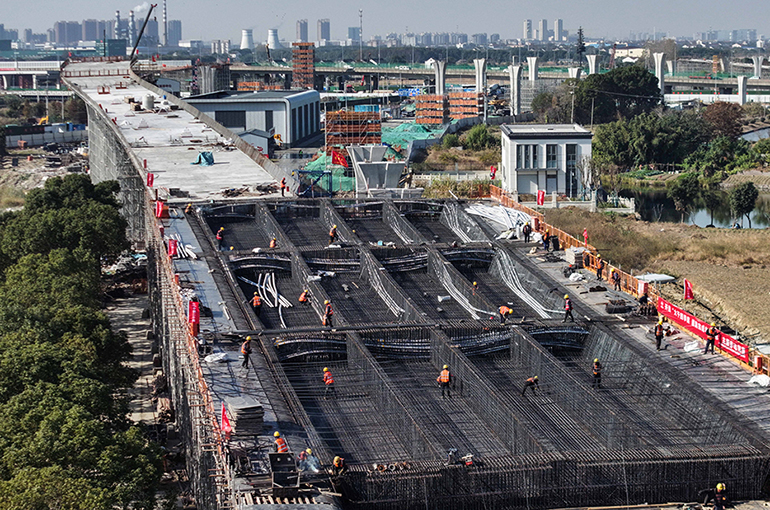
The swift issuance of bonds significantly influences investment activity. Wen Laicheng, a professor at the Central University of Finance and Economics, noted that infrastructure investments driven by government initiatives rose 8.9% in the first quarter year-over-year, reversing the decline seen in the previous year.
Of the bonds issued over the four months, roughly CNY 1.65 trillion—around 42%—were new issuance, while CNY 2.27 trillion, or 58%, consisted of refinancing bonds. These figures represent increases of about 10% and 11%, respectively, compared to the same period last year. Among the new bonds, about CNY 1.33 trillion were special bonds designed for new projects, up 12% from the previous year. A breakdown shows 28% allocated to municipal and industrial park infrastructure, 19% to transportation projects, 13% to affordable housing, 12% to land reserves, 10% to social services like healthcare and education, and 7% to agricultural, forestry, and water projects.
There are two main types of local government bonds: new bonds, primarily used for infrastructure, industrial, and social projects, and refinancing bonds, which are meant to repay maturing debt. New special bonds are included in government fund budgets, so they don’t add to the fiscal deficit.
In March, the National People’s Congress set a national quota of CNY 4.4 trillion for the annual issuance of local government special bonds—unchanged from the previous year.
Looking at the first four months, Zhong highlighted that infrastructure remains the main focus for fund allocation. There is increasing support for new infrastructure initiatives like telecom 5G base stations and data centers. Additionally, special bonds are being employed to upgrade urban neighborhoods and leverage existing commercial properties, supporting asset revitalization, affordable rental housing, and a dual-market housing system—measures that help stabilize the real estate sector.
Furthermore, these bonds work hand-in-hand with special treasury bonds and central budget funds, backing projects related to urbanization, emerging industry infrastructure, and the digital transformation of traditional facilities. These combined efforts aim to build a modern industrial system, stabilize the housing market, and finance basic livelihood projects.
 ChatGPT
 Perplexity
 Gemini AI
 Grok AI