Select Language:
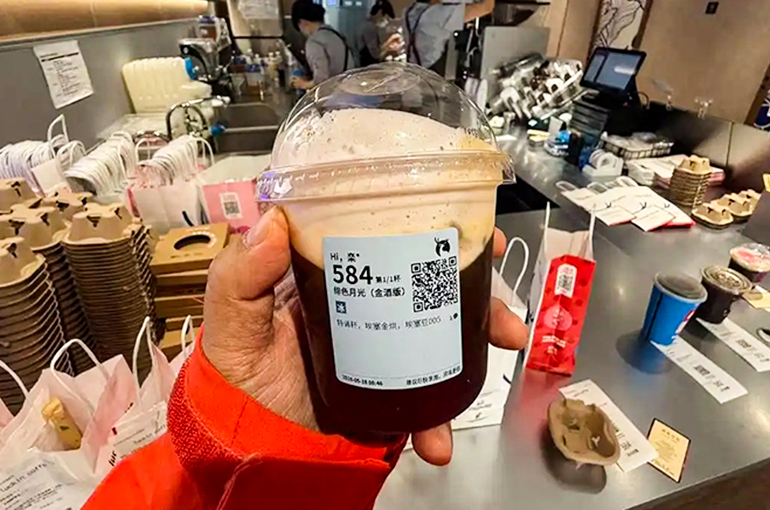
On May 18, a major coffee chain introduced two specialty alcoholic beverages at its cafes nationwide in China. This marks its entry into the “light buzz” segment as it explores new avenues for growth amid rising competition.
After today’s launch, these new drinks were not yet available at all locations in Beijing. They resemble fruity coffee drinks with a subtle alcoholic aftertaste, and their preparation is more intricate than standard coffee, resembling cocktail mixing.
The drinks contain 15 milliliters of gin and whiskey, respectively, giving them an alcohol content slightly above 0.5% by volume, according to staff at the stores. Under Chinese regulations, both fall under the category of alcoholic beverages, meaning they are only available for in-store pickup and cannot be sold to minors.
In 2023, the chain introduced a co-branded Moutai latte with Chinese distiller Kweichow Moutai. Since that product had an alcohol content below 0.5%, it was not classified as an alcoholic beverage.
Last month, the company reported a 3.6% decrease in net profit in the first quarter, despite a 35% revenue increase driven by faster store expansion and a rise in monthly active customers. The company, headquartered in Xiamen, expanded rapidly last year amid booming coffee consumption in China, operating 33,596 stores globally as of March 31.
Intensifying price competition among Chinese food delivery platforms is also pressure on profit margins for coffee chains, making new revenue sources and operational efficiencies vital.
Earlier this year, the company tested various alcohol-infused drinks at select stores in Shenzhen and Shanghai, using spirits such as gin, plum wine, and whiskey, industry sources told reporters.
The nationwide rollout of these two new specialty drinks comes after strong sales during the trial phase. However, whether they become regular offerings will depend on ongoing sales performance, the sources added.
Jiang Han, a senior researcher at Pangu Think Tank, believes this product innovation aims to make better use of in-store resources and improve overall profitability.
He noted that the coffee industry has moved past its rapid-growth phase driven by increased market size. Competition is now more focused on extracting more value from existing customers and filling market and usage gaps rather than just expanding store count and gaining new users.
Alcoholic beverages can help boost revenue for coffee brands but require adjustments in store setup and staff management, according to Zhu Danpeng, vice president of the Guangdong Food Safety Promotion Association.
He advises that new business models should be initially tested in a small number of outlets and gradually expanded, rather than being implemented widely without thorough validation.
 ChatGPT
 Perplexity
 Gemini AI
 Grok AI