Select Language:
Guangzhou Port has initiated full-scale construction on the fifth phase of the Nansha Port area, a project aimed at handling 6.7 million twenty-foot equivalent units (TEUs) each year and further increasing the southern Chinese shipping hub’s capacity.
Once finished, the annual container handling capacity at the Nansha Port area will rise to 35 million TEUs, making it one of the largest port complexes globally in terms of operational scale. The expansion will incorporate four new 200,000-ton deep-water container berths, along with multiple berths for inland waterway, coastal, and work vessels.
This development is expected to greatly enhance Guangzhou’s ability to accommodate ultra-large vessels and bolster ocean trunk-line services, thereby supporting the city’s growth as an international shipping center, according to Huang Bo, chairman of Guangzhou Port Group.
Upon completion, the fifth phase will operate alongside the existing 20 deep-water container berths capable of handling vessels weighing 150,000 to 200,000 tons. Additionally, four more deep-water berths are currently under construction at the port’s international general terminal.
### Advanced Dredging Technology Enables Major Capacity Growth
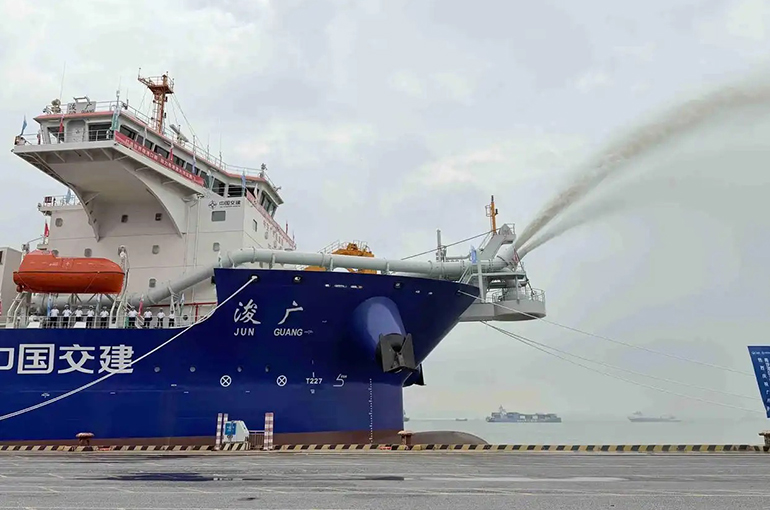
The project’s groundbreaking also introduced “Jun Guang,” a 35,000-cubic-meter trailing suction hopper dredger that is the largest of its kind in Asia. This vessel will facilitate dredging activities necessary for the port expansion, as confirmed during the ceremony.
“Jun Guang” features the world’s first adjustable-angle high-pressure water jet system installed on both sides of its bow. It can dredge to depths of about 120 meters below the seabed, with excavated sediments transported up to 12 kilometers to designated disposal sites.
The dredger’s overall efficiency surpasses traditional models by over 20 percent, thanks to an independently developed intelligent control system. This automation allows for fully autonomous dredging operations and maintains stable performance even in force 8 wind and wave conditions.
Since the first phase of Nansha Port started operations in September 2004, the port’s container throughput capacity has increased by roughly one million TEUs annually, reaching 22 million TEUs in 2025. This growth has significantly contributed to Guangzhou Port’s total container throughput exceeding 28 million TEUs last year.
 ChatGPT
 Perplexity
 Gemini AI
 Grok AI