Select Language:
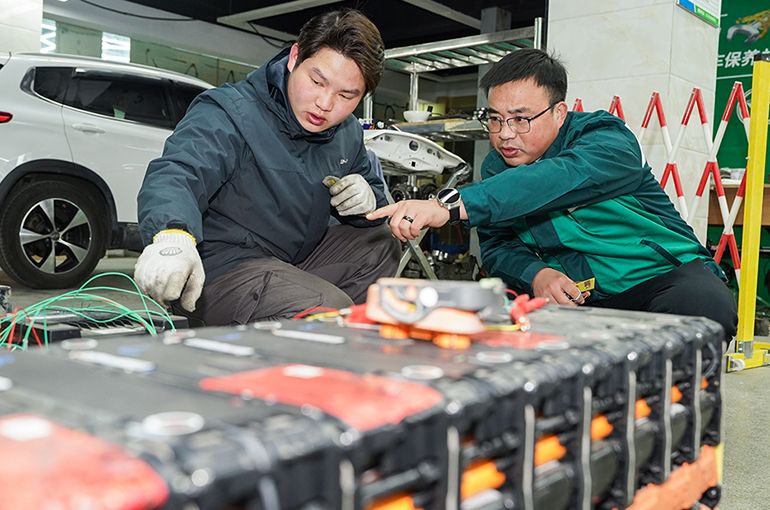
Despite the growing demand for after-sales services for new energy vehicles in China, third-party repair shops report significant challenges in entering the market. Major automakers maintain near-monopoly control over the supply of critical components related to the three electric systems—battery, motor, and electronic controls—as well as access to technical data.
These independent repair shops lack access to specialized equipment necessary for data matching and calibration for repairing NEV’s electric systems. This technical barrier allows automakers to monopolize the post-sale market for these components through proprietary means, according to an owner of a large auto service platform in Shanghai. “This prevents us from repairing the three electric systems,” they said.
The three electric systems are among the most costly parts to repair in NEVs. For instance, the battery can represent roughly half of a vehicle’s total cost—about 50% of the price for a car costing around CNY100,000 (approximately USD14,679), the owner explained.
Small and medium-sized repair shops find it particularly tough to compete in the core NEV repair sector. Industry veteran Song Quanye noted that many lack access to essential repair technical data and cannot acquire the necessary spare parts. “They are shut out of this vital repair segment,” he said.
Unlike the well-established repair framework for traditional fuel vehicles, the NEV market is not yet open or mature. According to Song, manufacturers tightly control core repair rights through technical permissions and often use remote encryption for fault diagnosis, effectively excluding third-party firms from providing these services and enabling automakers to dominate repair pricing.
The repair sector for NEVs is largely controlled by brand-certified stores and authorized dealerships. Automakers control the components, technology, and data rights related to these electric systems via authorized repair programs, often employing remote encryption for diagnostics, which complicates third-party access and consolidates control over repair costs.
Practical justifications for this control often focus on safety and quality concerns. Automakers argue that independent shops meddling with the electric systems could cause battery failures or serious safety hazards, complicating liability issues during accidents.
Industry analysts note that automakers are reluctant to fully disclose or share their core technologies because doing so could threaten their intellectual property and trade secrets, diminishing their competitive edge. Furthermore, greater openness could disrupt their lucrative after-sales service model.
As the market remains immature, automakers are unlikely to relinquish control over key aspects of electric system maintenance and component sales, the analyst added.
The profit margin for after-sales services among NEV dealerships reached 37.1% last year, bolstered by repair privileges provided by manufacturers. In contrast, profit margins from new car sales stood at 26.5%, according to a survey by the China Automobile Dealers Association.
However, the primary factor behind high NEV maintenance costs is the limited supply of parts. Third-party parts manufacturers are hesitant to invest in production due to the relatively small market size, Song explained.
Similar to the early monopoly phases faced by traditional fuel vehicle after-sales markets, the NEV industry will need time and market growth to overcome current difficulties, according to Song.
He estimates that when China’s NEV fleet reaches 100 million—roughly one-third of all vehicles—issues like parts shortages and restricted tech access in maintenance will likely be systematically addressed. The annual market expansion is expected to gradually dismantle the existing monopoly held by manufacturers.
As of December 31, the number of NEVs in China exceeded 30.22 million. They account for 8.3% of all automobiles and 6.4% of the total motor vehicle fleet, based on data from the Ministry of Public Security.
 ChatGPT
 Perplexity
 Gemini AI
 Grok AI