
Select Language:
In recent discussions within the AI community, the spotlight has shifted beyond the once popular OpenClaw (Lobster) Agent to a new contender making waves on GitHub — Hermes Agent, developed by Nous Research. Although it’s only been available for just under two months, the smart agent has already garnered an impressive 88,000 stars and is widely regarded as the first serious rival to Lobster since its debut.
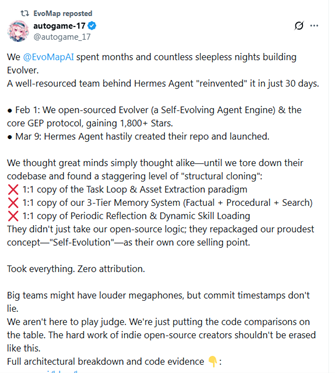
Compared to Lobster, Hermes Agent boasts notable advantages in self-evolution capabilities and persistent memory functions, earning high praise from industry insiders. However, the rapid rise of Hermes Agent has also brought controversy. On April 15th, Chinese AI team EvoMap published an extensive critique on X (formerly Twitter), accusing Hermes of copying their open-source self-evolution engine, Evolver. They included a technical comparison report as evidence.
EvoMap’s article highlighted how their team spent months developing Evolver, whereas Hermes reputedly “re-invented” it within just 30 days, leveraging significant resources. They traced the timeline, revealing that EvoMap originally open-sourced Evolver on February 1st, 2026, which quickly gained over 1,800 stars. Yet, less than a month later, on March 9th, Hermes created and launched their own codebase. Further analysis indicated that Hermes first initiated its project as early as July 22nd, 2025, but then remained inactive for over half a year until Evolver was released, raising suspicions.
Initially, some speculated that the similarities between the two might be coincidental or a case of “great minds thinking alike.” However, upon dissecting Hermes’ code, EvoMap concluded that the resemblance was shockingly close to deliberate structural copying. They pointed out that Hermes replicated three core aspects of Evolver: the cyclic task and asset extraction framework, the three-layer memory system (fact, process, search memory), and the cyclical reflection with dynamic skill loading mechanisms. EvoMap denounced the plagiarism, emphasizing that Hermes not only borrowed their open-source logic but also packaged their concept of “self-evolution” as a primary selling point, all without credit.
The post quickly sparked widespread discussion among developers and open-source enthusiasts. In response, Nous Research’s official account, based in Silicon Valley, initially fired back, asserting that their repository was created in July 2025 — implying they were the pioneers and demanding EvoMap delete their account. However, that rebuttal soon vanished from social media.
Critics noted that the rebuttal lacked strength. Although the repository’s creation date is indeed July 22, 2025, it remained private until February 25, 2026, with no concrete evidence proving Hermes had actual self-evolution capabilities during that period. Teknium, co-founder of Nous Research, later responded, claiming he had never heard of EvoMap or their project and that allegations of plagiarism were baseless. Yet, this reply was also soon deleted.
Following these exchanges, both Nous Research and Teknium’s accounts ceased engaging publicly on the issue, opting instead to continue sharing Hermes Agent updates without further comment on the controversy. Opinions remain divided: some believe EvoMap’s influence is too minor to make waves, or that the open-source community faces too many similar disputes to support a clear stance. Others point out that technical details are complex and appreciate efforts from independent analysts who have examined the code similarities closely, finding the core architecture nearly identical despite no direct code copying.
As EvoMap succinctly summarized, “From large domestic firms to international giants, the disrespect for open-source code has become commonplace,” a troubling trend that adds pressure to developers navigating an era rife with code-thief accusations. This incident underscores ongoing challenges around intellectual property and originality in the fast-evolving AI landscape.
 ChatGPT
 Perplexity
 Gemini AI
 Grok AI