

Select Language:
SpaceX, led by Elon Musk, is preparing for its tenth launch of the massive Starship rocket from Texas this Sunday, aiming to reach several key development milestones that previous tests, which ended in early failures, could not achieve.
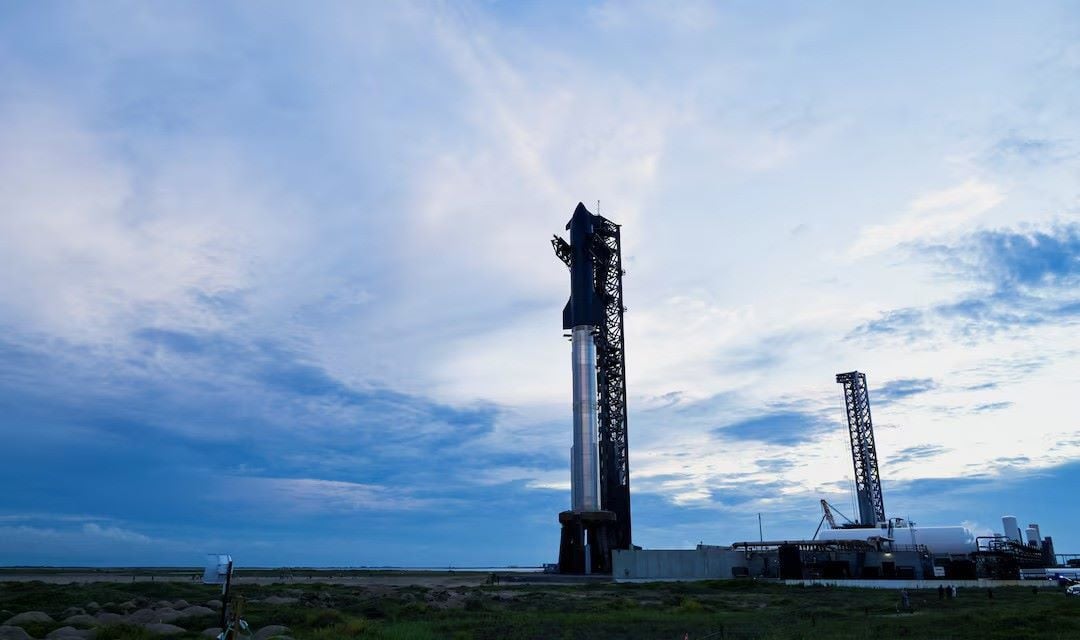
The launch stack, consisting of the 232-foot-tall Super Heavy booster and its 171-foot (52-meter) tall Starship upper stage, is positioned on a launch pad at SpaceX’s Starbase facility, with liftoff expected around 7:30 p.m. ET. Prior to the launch, Musk is expected to provide an update on the progress of Starship’s development.
This next-generation rocket, central to SpaceX’s future launch plans and Musk’s ambitions for Mars, has faced multiple setbacks this year. NASA’s goal is to utilize the rocket by 2027 for its first crewed lunar mission since the Apollo era.
Additionally, the success of SpaceX’s Starlink satellite internet project, a significant revenue source utilizing the Falcon 9 rocket, is closely linked to Starship’s development. Musk envisions deploying larger Starlink satellites with Starship’s increased lifting capacity to enhance the constellation’s bandwidth.
Throughout 2023, the company experienced two early-flight failures of Starship, a failure during a space test on its ninth mission, and a large-scale explosion in June on a test stand that scattered debris into nearby Mexican territories. These challenges have tested SpaceX’s rapid iteration, as the company continues to produce new Starships for upcoming tests at its extensive Starbase facilities.
These obstacles highlight the technical complexity involved in Starship’s latest version. Notable upgrades include more powerful engines, a more durable heat shield, and stronger steering flaps—vital components for atmospheric reentry and rapid reusability, a vision Musk has championed for years.
On Sunday evening, after stacking the rocket, it will launch from Texas. During ascent, the Starship upper stage will separate from the Super Heavy booster at high altitude. Instead of returning to land on its own, the Super Heavy booster will attempt a soft water landing in the Gulf of Mexico using a backup engine configuration, a different approach from previous land landings.
Meanwhile, Starship will ignite its engines briefly to travel further into space. It will attempt to deploy its first set of mock Starlink satellites and will reignite an engine during a suborbital loop around Earth.
Approximately an hour into the mission, Starship will reenter Earth’s atmosphere over the Indian Ocean — a critical phase to test its heat shield tiles and engine flaps designed to withstand intense heat and aerodynamic stress, reminiscent of past issues that damaged the rocket’s exterior.
SpaceX states, “Starship’s reentry profile is intentionally designed to challenge the structural limits of the upper stage’s rear flaps during maximum entry dynamic pressure.”
 ChatGPT
 Perplexity
 Gemini AI
 Grok AI

