

Select Language:
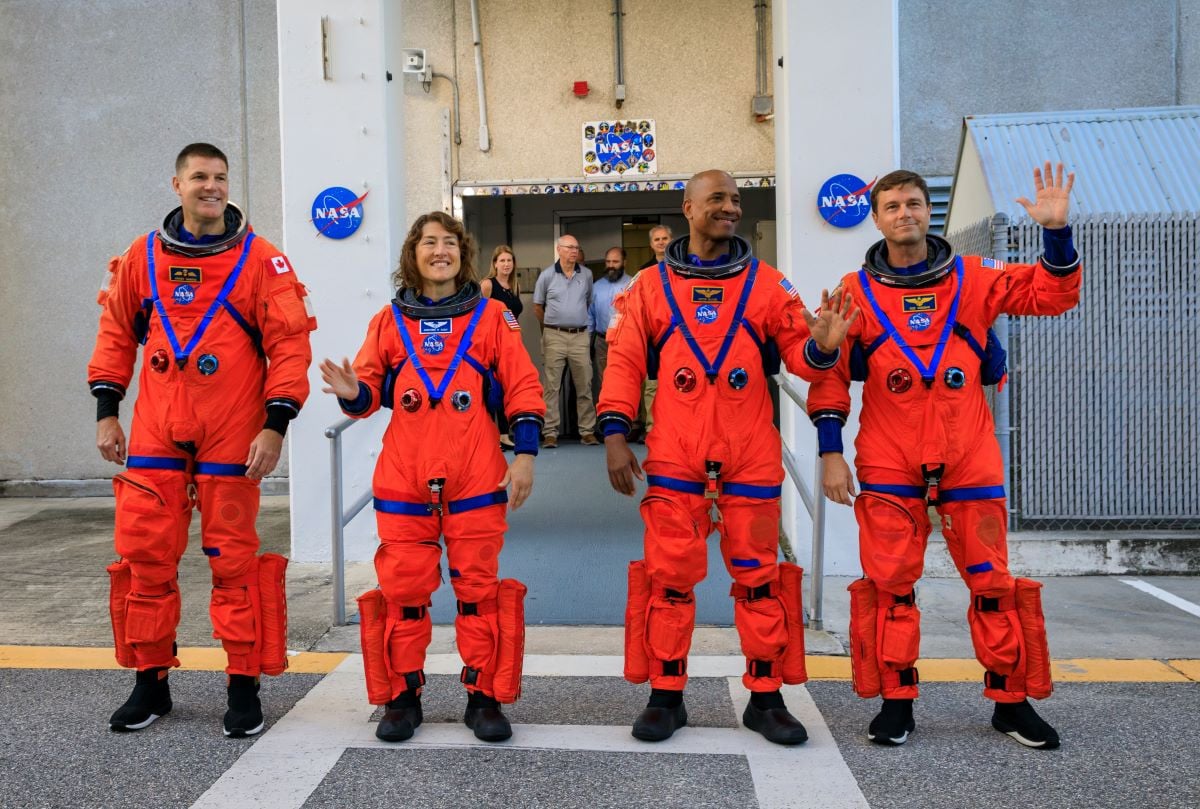
Three American and one Canadian astronaut are preparing for a 10-day Orion mission, pushing farther into space than humanity has before. The mission will involve orbiting the moon and returning, marking the first crewed test flight of NASA’s Artemis program—America’s effort to return humans to the lunar surface and establish a sustainable presence.
The launch, scheduled for Wednesday, will send the crew aboard NASA’s Orion capsule on a mission that’s expected to last 10 days, making it the first crewed mission since Apollo 17 in 1972. This mission aims to test critical systems and pave the way for future lunar explorations, with a target to land on the moon’s rugged south pole by 2028.
NASA’s Artemis program, with an estimated budget of over $93 billion since 2012, seeks to restart human landings on the moon and develop a platform for future Mars missions. The U.S. is the only nation to have sent humans to another celestial body, accomplishing six Apollo moon landings driven by Cold War rivalry with the Soviet Union. Now, NASA faces competition from China, which has made steady progress in lunar exploration and plans to land astronauts on the moon by 2030.
Artemis II features astronauts Christina Koch, Victor Glover, Reid Wiseman, and Jeremy Hansen—the first Canadian astronaut to approach the lunar vicinity—all participating in this historic test flight. Hansen’s inclusion stems from a 2020 agreement between NASA and the Canadian Space Agency, recognizing Canada’s contributions to space robotics and exploration.
NASA is partnering with private companies to develop a commercial lunar market, hoping to stimulate future economic activities on the moon. Boeing and Northrop Grumman lead the Space Launch System (SLS), and Lockheed Martin constructs the Orion capsule. Meanwhile, SpaceX and Blue Origin are developing lunar landers funded by NASA, with plans to commercialize lunar operations.
Analysts project that lunar surface activities could generate up to $127 billion by 2050, with investments of around $72-88 billion. However, experts emphasize that, for now, government-led infrastructure—such as energy and communication systems—will be essential for lunar development, as commercial growth remains limited without significant government support.
The Artemis II mission will serve as a critical test for NASA’s Orion capsule and SLS rocket, evaluating life-support, navigation, and communication systems in preparation for future lunar landings. Liftoff is targeted for April 1, with a potential window extending into early April, contingent on weather and technical considerations. A subsequent launch window opens on April 30, based on orbital mechanics.
The follow-up Artemis III mission, planned for 2027, will involve docking the Orion capsule in Earth’s orbit with lunar landers from Blue Origin and SpaceX, demonstrating the ability to transfer astronauts before landing on the moon. This mission’s schedule was adjusted by NASA’s new administrator, billionaire Jared Isaacman, whose changes introduced new objectives and pushed the lunar landing to Artemis IV.
 ChatGPT
 Perplexity
 Gemini AI
 Grok AI

