

Select Language:
China is at the forefront of innovation, showcasing advancements from kung-fu robots to viral AI-generated videos, all aligned with Xi Jinping’s technology-driven vision.
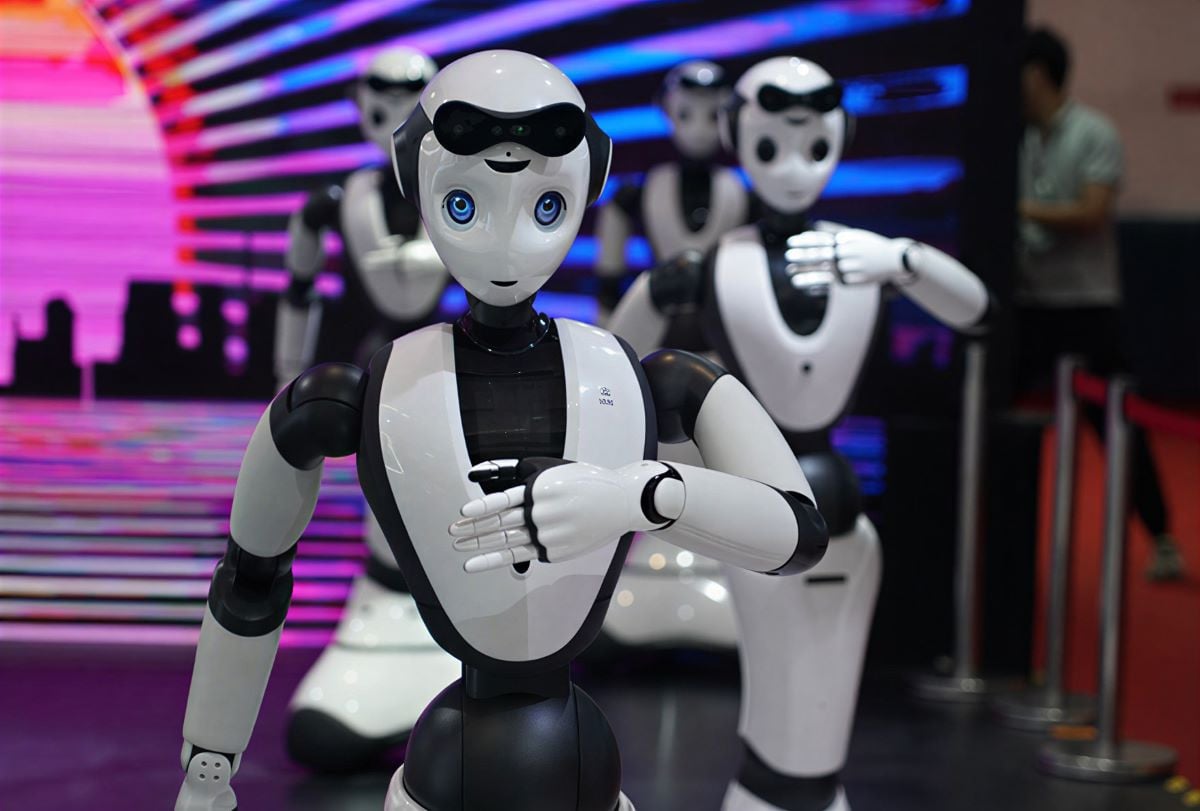
A Unitree Robotics humanoid robot participated in the freestyle segment at the inaugural World Humanoid Robot Games held at the National Speed Skating Oval in Beijing on August 15, 2025. PHOTO: REUTERS
From robots that perform martial arts to artificial intelligence models producing viral videos, China is transforming imagination into tangible reality, captivating global audiences.
“Innovation is development; innovation is the future,” asserted Chinese President Xi Jinping—a guiding principle that has shaped China’s evolution over the past ten years.
Since assuming leadership, Xi has directed the country toward an innovation-centric trajectory, leveraging a powerful surge of technological breakthroughs and industrial transformation with strategic foresight.
Today, China’s surge in innovation is not only fueling national growth but also redefining global opportunities. As the annual ‘Two Sessions’ commence the first year of the 15th Five-Year Plan (2026–2030), all eyes are on China’s blueprint for blending cutting-edge progress with international cooperation, fostering a future where advancement and shared prosperity coexist.
China’s emergence as a global innovation leader isn’t accidental; it results from a meticulously planned, long-term strategy executed in deliberate stages.
During the first “Two Sessions” after the 18th National Congress of the Communist Party in 2013, President Xi emphasized the importance of an independent innovation path, extensive reforms in science and tech sectors, and transforming China from a major economy into a truly influential economic powerhouse.
Innovation remains central to subsequent development strategies: both the 13th and 14th Five-Year Plans emphasized technological progress, with the 15th Plan mentioning “technology” and “innovation” 46 and 61 times respectively, reinforcing China’s commitment to shaping its future through advanced development.
Clemens Schuette, chair of the German-Chinese Business Association, noted that innovation is a long-term national strategic choice, not just a temporary policy focus. “China’s innovation-driven approach is shaping global technological progress,” he added.
Read More: China elevates its tech race with the U.S as economic imbalances deepen
President Xi has emphasized innovation as the main catalyst for development, implementing high-level initiatives to promote industrial breakthroughs, new business models, and growth engines. By harnessing cutting-edge technologies, China seeks to unlock its full productive potential, modernize traditional industries, and expand emerging sectors—transforming innovation into economic growth.
A large screen displayed news footage of China’s lunar exploration endeavors, including the Chang’e-6 mission carrying the Chinese national flag on the moon’s far side, in Beijing on June 4, 2024. PHOTO: REUTERS
Foreign leaders have experienced China’s advanced manufacturing firsthand: South Korean President Lee Jae Myung shook hands with a Chinese robot, Uruguayan President Yamandu Orsi rode a high-speed train, and German Chancellor Olaf Scholz tested driver-assistance systems developed in collaboration with Chinese companies. The WIPO Global Innovation Index 2025 ranked China among the top 10 countries worldwide for the first time.
What factors contribute to China’s innovation success? Analysts point to the country’s strategic mobilization of resources. During a visit to a national IT innovation park in February 2026, Xi called for pooling resources to achieve breakthroughs in critical technologies.
The 15th Five-Year Plan emphasizes unconventional measures to secure significant advances in key areas such as integrated circuits, industrial machinery, high-end equipment, software, advanced materials, and biomanufacturing.
Lawrence Loh of the National University of Singapore Business School remarked that China’s comprehensive, whole-of-nation approach—integrating public and private sectors across various levels of government—is unmatched globally.
China drives innovation at all levels, from space exploration efforts like the Chang’e lunar missions to 5G-powered telemedicine services reaching remote rural communities. Experts describe this seamless ecosystem as a key differentiator.
A 3D-printed, minimalist turbojet engine developed independently by the Aero Engine Corporation of China (AECC) completed its first flight in November 2025, marking a significant milestone. PHOTO: Screenshot from China Central Television’s military channel
International collaborations bolster China’s innovation landscape, with partnerships spanning over 160 countries. Chinese electric vehicles are manufactured in Europe, European automakers engage in joint R&D projects in China, and global pharmaceutical companies expand research hubs within the country.
Read Also: China focuses on ‘quality growth’ with a realistic GDP target
Xi highlighted the global importance of innovation during the 28th APEC Economic Leaders’ Meeting in 2021, emphasizing that it drives worldwide progress. China advocates for international cooperation, openness, and knowledge sharing to address global development challenges.
At the Shanghai Cooperation Organization (SCO) Tianjin Summit, member nations agreed to strengthen collaborative efforts in science, technology, and innovation, launching the China-SCO Sci-Tech Innovation Cooperation Centre.
China continues to position itself as a key player in global innovation, with the BeiDou Navigation Satellite System serving over 140 countries and high-speed rail technology providing worldwide transportation solutions.
Through initiatives like the Belt and Road, SCO, and BRICS, China actively shares technology and market opportunities globally, according to Ruslan Yesin, head of the Belarusian Communist Party’s SCO and BRICS Department.
 ChatGPT
 Perplexity
 Gemini AI
 Grok AI

