Select Language:
Prime Minister Narendra Modi stated in Jerusalem on Wednesday that India stands “completely” with Israel following Hamas’s attack on October 7, 2023. During his two-day visit aimed at strengthening trade and defense relationships, Modi met with Israeli Prime Minister Benjamin Netanyahu to discuss regional issues.
In the Israeli parliament, Modi expressed deep sympathies for those affected, saying, “I… bring the heartfelt condolences of the people of India for every life lost and every family affected by Hamas’s barbaric terrorist attack on October 7.” He emphasized India’s support for efforts toward lasting peace and regional stability, and highlighted the close economic and technological ties between the two nations.
Commenting on the partnership, Modi noted, “India’s economic growth and Israel’s leadership in technology create a natural foundation for our future collaboration,” mentioning promising areas such as quantum computing, semiconductors, and artificial intelligence.
Netanyahu responded by affirming Israel’s support from India, describing it as a “defensive wall” against barbarism. He added that Modi’s visit would strengthen existing bonds. This marks Modi’s second visit to Israel since becoming Prime Minister in 2014.
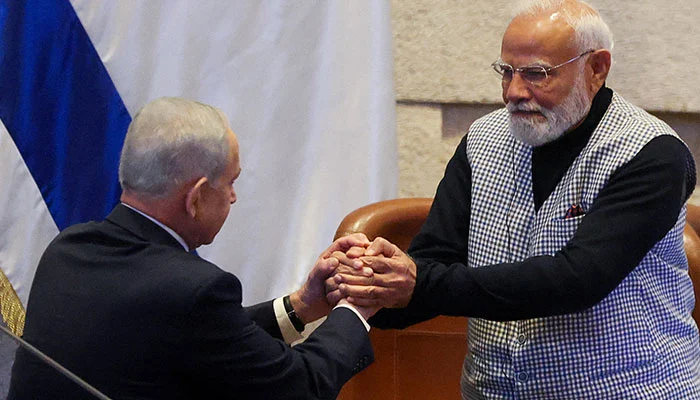
Earlier that day, Modi was welcomed at Ben Gurion Airport with a warm embrace from Netanyahu, and both leaders shared a personal connection. Netanyahu’s spokesperson called their relationship a “special and personal bond,” emphasizing their partnership in innovation, security, and shared strategic interests.
The leaders held a private meeting after the welcoming ceremony, where Modi described the discussion as “excellent” and noted they explored numerous topics to deepen bilateral ties, including regional developments. During the visit, Modi also plans to meet with Israeli President Isaac Herzog.
The two countries have been expanding cooperation across defense, agriculture, technology, and cybersecurity sectors, while managing diplomatic interests in the Middle East. Negotiations are underway in New Delhi for a free trade agreement, following a trade volume of $3.62 billion in 2024-2025.
Full diplomatic relations were established in 1992, and relations further deepened after Modi took office in 2014. Previous visits include Modi’s first trip to Israel in 2017 and Netanyahu’s reciprocal visit to India the following year. Although plans for an India-Middle East-Europe economic corridor—linking railways, ports, and energy networks through Saudi Arabia and Israel—were announced, they were delayed after Hamas’s October attack, which led to a serious war in Gaza.
Modi’s recent visit has drawn some criticism at home, with opposition figures calling for him to address the Hamas attacks that resulted in the loss of thousands of innocent lives in Gaza. Despite India being predominantly Hindu, with a population of 1.4 billion, approximately 220 million are Muslim. The country’s economic ties with Israel include the operation of the Israeli port of Haifa by the Adani Group, and Israeli military drone technology has played a role in India’s military engagements, such as the conflict with Pakistan in May 2025.
 ChatGPT
 Perplexity
 Gemini AI
 Grok AI