Select Language:
Ukraine has abandoned its goal of joining NATO in exchange for security guarantees from Western allies, as a compromise to bring an end to the conflict with Russia, President Volodymyr Zelensky announced Sunday during peace negotiations in Berlin.
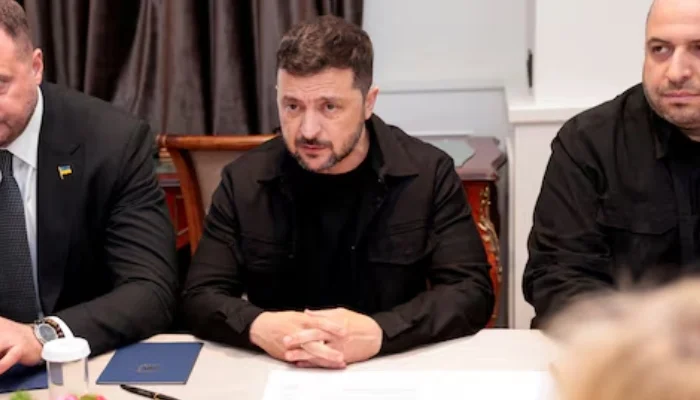
Zelensky revealed this shift in stance as he traveled to Berlin, where he held discussions with U.S. envoy Steve Witkoff and Jared Kushner, President Donald Trump’s son-in-law, to seek an end to Europe’s bloodiest war since World War II.
This change signifies a major policy shift for Ukraine, which has long sought NATO membership as a defense against Russian aggression, with such an aspiration enshrined in its constitution. The move also aligns with one of Russia’s war objectives, although Kyiv has so far stood firm against ceding territory to Moscow.
Zelensky met with the US negotiators at talks hosted by German Chancellor Friedrich Merz, who reportedly made brief remarks before the sides continued negotiations. Other European leaders are scheduled to arrive in Germany for discussions on Monday.
Instead of NATO membership, Zelensky said Ukraine is focusing on security guarantees from the U.S., Europe, and other partners. These guarantees are viewed as a compromise by Kyiv and are meant to serve as a safeguard against future Russian invasions.
“From the outset, Ukraine’s goal was to join NATO, which would provide real security guarantees. Unfortunately, some partners in the US and Europe did not support this path,” Zelensky explained in a WhatsApp interview with reporters.
“Therefore, today we are considering bilateral security guarantees from the US—similar to NATO’s Article 5—along with assurances from European allies, Canada, Japan, and others as a way to prevent another Russian invasion,” he added.
Zelensky emphasized that these guarantees should be legally binding. Meanwhile, Russian President Vladimir Putin has repeatedly demanded that Ukraine formally renounce NATO ambitions, withdraw troops from roughly 10% of Donbas still under Kyiv’s control, and declared that Ukraine must remain neutral, with no NATO troops presence.
Reports earlier this year indicated that Putin seeks a written pledge from major Western powers explicitly promising not to expand NATO eastward, effectively ruling out Ukraine, Georgia, Moldova, and other former Soviet states from joining the alliance.
Prior to these negotiations, Zelensky called for a “dignified” peace with security assurances that Russia would not attack Ukraine again. Under pressure from former President Trump to sign a peace agreement aligned with Moscow’s demands, Zelensky accused Russia of prolonging the war through brutal bombings and attacks on Ukraine’s energy and water infrastructure.
Sending Witkoff, who has led negotiations with Ukraine and Russia on U.S. peace proposals, signals that Washington sees a real chance for progress nearly four years after Russia’s invasion in 2022.
Zelensky indicated that Ukraine, Europe, and the U.S. are exploring a 20-point plan, aiming to achieve a ceasefire, although Kyiv is not directly engaging in talks with Moscow. A possible option discussed is establishing a ceasefire along the current front lines.
European nations—including Britain, France, and Germany—are working to refine these U.S. proposals, which, as revealed in a draft last month, call for Ukraine to cede additional territory, abandon NATO aspirations, and accept limits on its armed forces.
This period of negotiations is seen as a pivotal moment that could determine Ukraine’s future, with European allies also looking to bolster Kyiv’s finances using frozen Russian assets for military and civilian needs.
Earlier in December, Russian officials met with Witkoff and Kushner in a meeting that the Kremlin described as “constructive,” though no major breakthroughs occurred.
Zelensky continues to deal with widespread power outages caused by Russian strikes targeting energy, heating, and water supplies, affecting hundreds of thousands across Ukraine. He accused Russia of deliberately dragging out the conflict and causing maximum harm to Ukrainian civilians.
Since Russia’s full-scale invasion, relationships with Western nations have sharply deteriorated, with NATO and European leaders warning that Putin’s ambitions will not be limited to Ukraine. NATO Secretary General Jens Stoltenberg recently emphasized the need for NATO to prepare for a conflict of the scale experienced in the past, warning that “we are Russia’s next target,” a claim the Kremlin has dismissed.
Kremlin spokesperson Dmitry Peskov criticized the statement, suggesting it demonstrated a disconnect from reality about World War II, calling it an irresponsible remark that shows a lack of understanding.
 ChatGPT
 Perplexity
 Gemini AI
 Grok AI