Select Language:
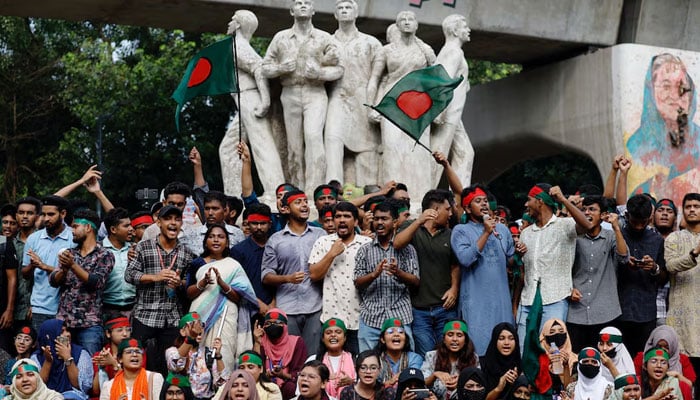
Activists from the Anti-Discriminatory Student Movement gather at the University of Dhaka’s Teacher-Student Center (TSC) during anti-quota protests in Dhaka, Bangladesh, on August 13, 2024. — Reuters
- Rallies take place in Dhaka to highlight the student-led movement.
- Interim leader Yunus plans to speak to crowds outside parliament.
- He warns that former autocrats are plotting to hinder progress.
Bangladesh’s interim leadership commemorated the one-year anniversary of ousting Sheikh Hasina’s authoritarian rule by urging citizens to seize the “moment of opportunity” for reform.
Muhammad Yunus, who holds the Nobel Peace Prize and leads the caretaker government as chief advisor until the upcoming elections, issued a warning about those attempting to reverse the country’s recent gains.
“Today is a historic chapter in Bangladesh’s history,” Yunus said, celebrating the day that he claims freed the nation from decades of oppressive control.
The South Asian country, home to roughly 170 million people, has been embroiled in political instability since a student uprising toppled then-Prime Minister Sheikh Hasina on August 5, 2024, ending her 15-year tenure.
The anniversary is a national holiday, with most streets in Dhaka remaining quiet as many Bangladeshis choose to relax rather than participate in protests.
Yunus is scheduled to address demonstrators outside parliament later in the evening, where he and leaders of major political parties will deliver a “proclamation.”
Conspiracy to Undermine Progress
Hasina’s time in power was marked by serious human rights violations, including mass arrests and extrajudicial killings of her political opponents. Yunus is committed to reforming and strengthening democratic institutions.
“The sacrifices of thousands have provided us with this rare chance for national renewal, and we must protect it at all costs,” Yunus stated in a letter released for the anniversary.
He expressed concern that the retired autocrats and their allies continue to plot to derail the progress Bangladesh has made.
While the interim government has pursued many reforms, reaching agreements on preventing a return to authoritarian rule remains a challenge. Progress has been slow amid political jockeying ahead of elections expected in early 2026.
“Discussions are ongoing with political parties and stakeholders regarding essential reforms, including changes to the political and electoral systems,” Yunus added.
 ChatGPT
 Perplexity
 Gemini AI
 Grok AI