Select Language:
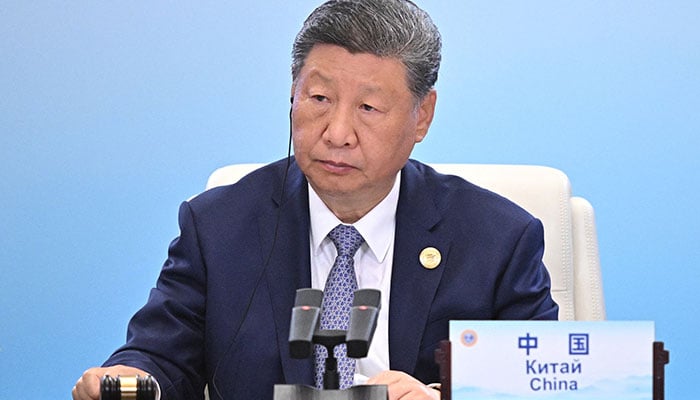
Chinese President Xi Jinping announced the Global Governance Initiative (GGI) during the Shanghai Cooperation Organization Plus summit in Tianjin on Monday, emphasizing the need for a fairer and more balanced global governance framework.
“I’m eager to collaborate with all nations to build a more just and equitable international system and work towards a community with a shared future for humanity,” Xi stated in his speech.
The SCO, which includes China, India, Russia, Pakistan, Iran, Kazakhstan, Kyrgyzstan, Tajikistan, Uzbekistan, and Belarus, promotes a collaboration model different from Western-led alliances and aims to serve as an alternative in global partnerships.
The Chinese leader outlined the initiative’s core principles: respecting sovereignty, adhering to international laws, supporting multilateralism, prioritizing people-centered policies, and emphasizing concrete actions.
“We must stand firmly against hegemonism and power politics and practice genuine multilateralism,” Xi declared, subtly criticizing the current US-dominated global order.
Alongside Russian President Vladimir Putin, Xi called for a global security and economic system that centers on the interests of the Global South.
He proposed establishing a new SCO development bank, signaling a significant step toward creating an alternative payment system or common currency to bypass the US dollar.
Beijing pledged to provide 2 billion yuan (approximately $280 million) in free aid to member countries this year, along with an additional 10 billion yuan in loans to an SCO banking consortium, Xi revealed.
China also plans to set up an artificial intelligence cooperation center for SCO members and invites these nations to participate in China’s lunar research station efforts.
Earlier, Xi advocated for more inclusive global economic globalization amidst upheavals caused by the Trump administration’s tariffs, highlighting the SCO’s large market potential and economic opportunities in energy and scientific research.
The summit, which also involves 16 observer and dialogue partner countries, began on Sunday, just days before a major military parade in Beijing commemorating 80 years since the end of World War II.
During the summit, member states agreed to enhance cooperation in security and economic sectors and unanimously welcomed Laos as a dialogue partner, according to China’s official Xinhua news agency.
Xi engaged in a series of bilateral meetings with leaders including Belarusian President Alexander Lukashenko—an ally of Putin—and Indian Prime Minister Narendra Modi, who is visiting China for the first time since 2018.
 ChatGPT
 Perplexity
 Gemini AI
 Grok AI