Select Language:
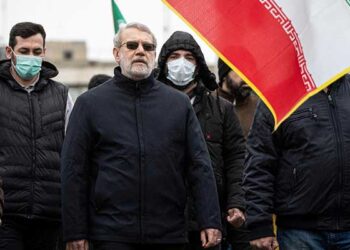
Ali Larijani, born in 1958 in the city of Najaf, Iraq, which is renowned for its significant Shiite Muslim shrine, was a prominent Iranian politician and a key figure in the Islamic Republic’s political landscape. After moving to Iran during his childhood, he focused on his education, earning a doctorate in philosophy. Growing up in a family deeply rooted in religious and revolutionary circles, Larijani was acutely aware of the upheavals sweeping through Iran in the 1970s.
At 20, he witnessed the fall of the Shah and the rise of Ayatollah Khomeini’s regime. Following Iran’s 1979 Islamic Revolution, Larijani joined the Islamic Revolutionary Guards Corps (IRGC) during the Iran-Iraq War, quickly rising through ranks as a staff officer focusing on logistical and organizational duties. His family’s influence and his military success facilitated his ascent in the new Islamic state.
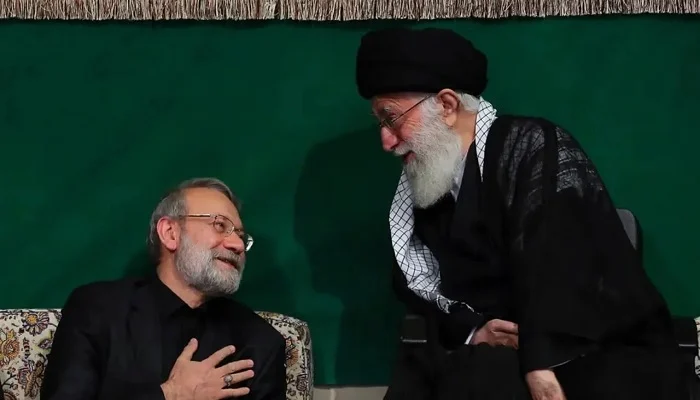
Post-war, he served as Iran’s culture minister and later led the national broadcaster, IRIB, playing a crucial role in shaping ideological narratives. He was appointed to the cabinet by President Ali Akbar Hashemi Rafsanjani and served as speaker of parliament for 12 years, during which he navigated the complex power struggle between Rafsanjani and Khamenei. His tenure at IRIB and his subsequent roles gave him a front-row seat to Iran’s internal political conflicts.
Larijani also served as head of the Supreme National Security Council and was Iran’s chief nuclear negotiator from 2005 to 2007. During this time, he fiercely defended Iran’s right to develop nuclear technology while balancing diplomatic pressures from the West. His pragmatic approach involved frequent meetings with Russian and Chinese officials, helping to manage Iran’s regional and international relations.
As parliament speaker from 2008 to 2020, Larijani was instrumental in advocating for Iran’s nuclear program, including during the negotiations that culminated in the 2015 nuclear deal, which was later abandoned by the Trump administration in 2018. In recent years, he returned to lead the Supreme National Security Council amid escalating tensions and Israeli strikes. His diplomatic efforts aimed at de-escalating conflicts and maintaining Iran’s sovereignty, even as internal and external pressures increased.
Larijani’s career reflects his close ties to Iran’s military, religious, and political institutions, and his pragmatic yet unwavering commitment to safeguarding Iran’s theocratic system and national interests.
 ChatGPT
 Perplexity
 Gemini AI
 Grok AI