Select Language:
Purchasing shoes often involves making compromises—one foot slightly smaller than the other, or settling for off-the-shelf options that never quite fit right.
While custom-made shoes have been around for centuries, they typically come with a hefty price tag. I’ve previously paid $500 for custom orthotics—before even buying the shoes. That’s a significant investment for footwear that still might not fit perfectly.
Why not leverage 3D printing and AI to solve this problem? That’s exactly what Syntilay aims to do, and I recently had the chance to experience their process firsthand.
### A New Type of Footwear?
Syntilay combines advanced foot scanning technology, artificial intelligence, and 3D printing to craft shoes tailored specifically for each person’s feet—at prices under $200.
Their initial offerings include a stylish slide sandal and sneaker, designed more for everyday wear than intense athletic activity. Both models feel surprisingly comfortable thanks to a soft, flexible plastic blend of nylon and TPU. Their designs, generated with the help of AI and influenced by a creative director, sport a modern, edgy aesthetic inspired by futuristic themes.
### How the Process Works
Ben Weiss, Syntilay’s CEO, explained that their scanning technology gathers 5,000 data points and 12 key measurements—everything from forefoot width and arch height to instep girth. This comprehensive data guides the 3D printing, creating shoes that truly understand the unique shape of your feet.
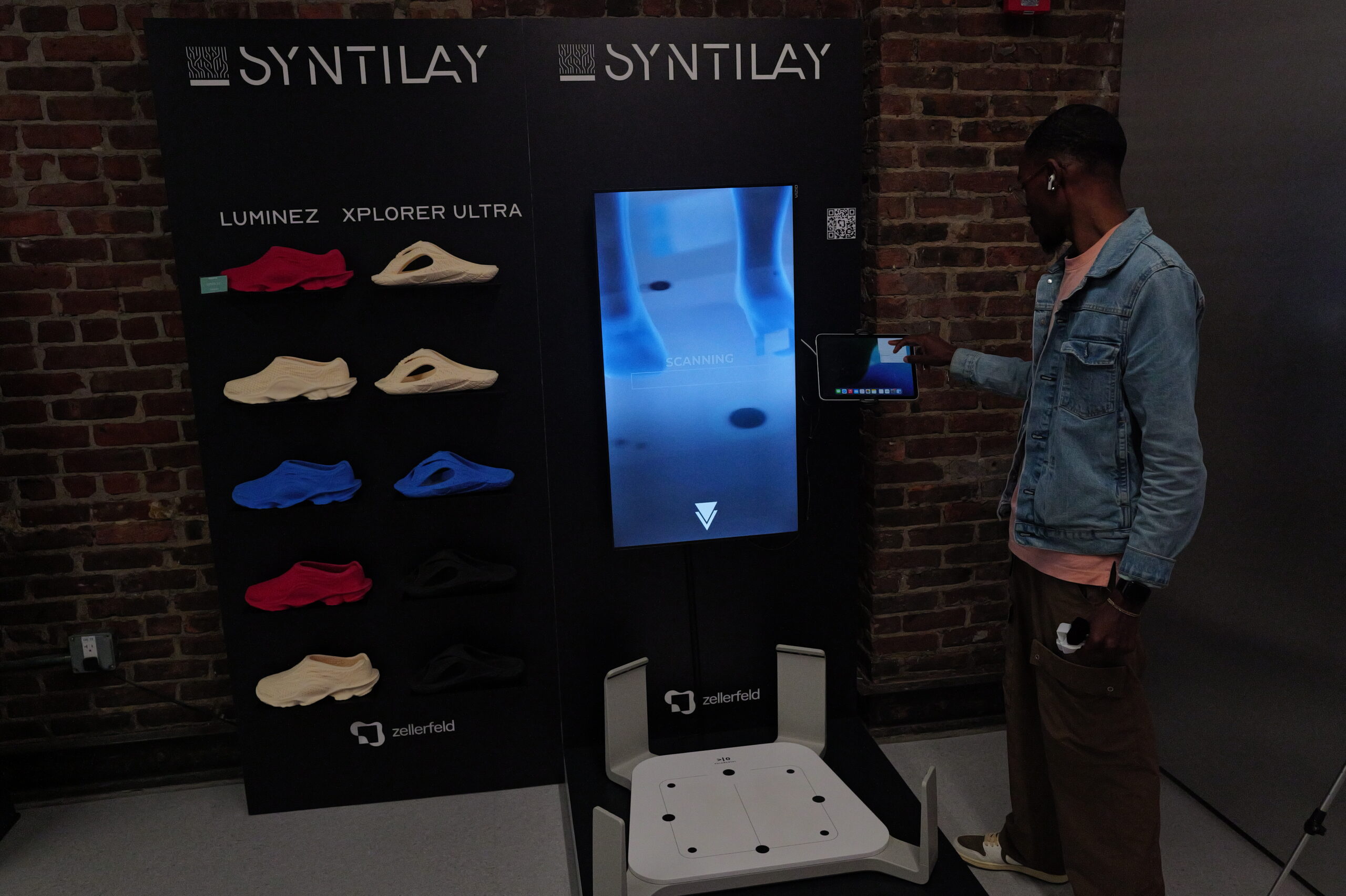
Most customers will use a smartphone app to biometrically scan their feet via a link sent after purchasing. I had the opportunity to test the full experience at a new Syntilay store in Times Square, New York.
The process is quick and user-friendly: roll up your pants, step onto the Volumental scanner, and answer a few simple questions on a touchscreen. Within minutes, the custom measurements are recorded, and the shoes are ordered. Turnaround time for production is about four to six weeks, so I’ll have to wait a bit to see how they perform in everyday use.
This is currently the only location offering the complete scanning service, but the company plans to expand to a dozen locations across North America and Asia by 2026.
### Past and Future
Syntilay isn’t new to custom footwear—earlier this year, they launched a program that creates shoes from smartphone photos and measurements. That initiative has been well-received, with only one pair returned so far, and a quick turnaround for replacements.
The advent of AI-designed shoes means style will be as important as fit. The designs are not only tailored for comfort but also crafted to appeal visually, with sleek patterns inspired by spacecraft and yacht design elements.
### The Shoes
The Xplorer slide, for example, combines a sense of luxury and futurism, drawing visual inspiration from yacht decks and high-tech spacecraft art. Meanwhile, the Luminez sneaker resulted from over 100 iterations of AI-driven design, culminating in what Weiss describes as their most optimized look and fit yet.
I’m excited to see how these shoes perform once they arrive—once I get them, I’ll share my impressions. The shoes are produced in about four to six weeks, and at the moment, the full scanning experience is available only at select locations. However, expansion plans suggest you might be able to get fully customized shoes far closer to home soon.
### Final Thoughts
For those who’ve ever wished their shoes could be made just for them, Syntilay’s approach makes that a real possibility—while keeping the price accessible. It’s a promising step toward footwear that marries perfect fit, innovative design, and affordability.
 ChatGPT
 Perplexity
 Gemini AI
 Grok AI