Select Language:
Tehran is attempting to block the crucial Strait of Hormuz to oil shipments following U.S. and Israeli strikes against Iran. There are concerns that Iran might be using sea mines as a weapon to achieve this. U.S. forces have targeted 28 Iranian mine-laying vessels, according to President Donald Trump on Wednesday, marking over a week since the Middle East conflict escalated.
If Iran deploys mines in the key shipping lane, as it did in the 1980s, it would create a nightmare for Western mine-clearing operations. Here’s what you need to know:
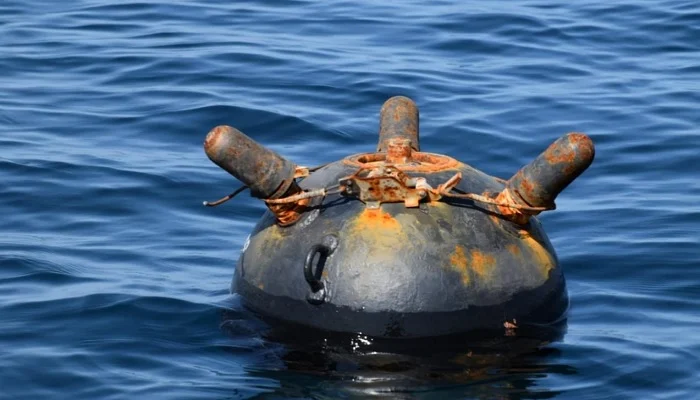
What are sea mines?
Sea mines are often considered the “weapon of the poor,” as a former senior French Navy officer described. Despite their simplicity, they represent a significant threat to maritime trade and naval freedom of movement.
Iran’s mine inventory
Estimates suggest Iran possesses around 5,000 to 6,000 naval mines, including difficult-to-intercept drifting mines. Contact mines float on the sea surface or are anchored to the seabed and detonate upon contact with a vessel’s hull. Iran also has influence mines suited for the shallow waters of the Gulf, which are planted on the seabed and trigger when a large ship passes overhead. Speedboats could also be used to attach limpet mines to ships, set to explode after a specific time.
The U.S. Defense Intelligence Agency reported in 2019 that Iran can quickly deploy these mines across the Persian Gulf and Strait of Hormuz using small, fast boats equipped as minelayers. Many of Iran’s small boats, including the Ashoora class, have mine rails capable of carrying at least one mine. Alternatively, smaller vessels could be converted to discreetly deploy mines.
Historical usage of sea mines
Iran deployed sea mines during its conflict with Iraq in the 1980s, particularly during the “tanker war,” which forced U.S. naval escorts for commercial ships. During the 1991 Gulf War, Iraqi forces laid approximately 1,300 mines, damaging two U.S. Navy ships severely—costing around $100 million to repair one of them, the USS Princeton. It took over two years of dedicated mine-clearance efforts to declare the northern Gulf free of mines.
Mining and demining operations
Western countries possess the capabilities to clear the Strait of Hormuz if needed, but such operations would be lengthy and complex. In January, the U.S. removed four Avenger-class mine hunters based in Bahrain, planning to replace them with ships equipped with mine countermeasure tools—though these substitutes are not specifically designed for mine clearance.
The Center for Maritime Strategy warned last year that strategically placed sea mines could become a critical vulnerability for U.S. naval operations, noting that Iran, China, and Russia have acquired these inexpensive weapons. However, the fleet is dismantling its mine-countermeasure capabilities without replacing them with proven alternatives.
Europe’s capabilities, while better than the U.S., remain insufficient against present threats. Britain withdrew its last four Gulf-based mine hunters in December—down from 13. France currently owns only eight specialized ships, which have not recently operated in the Gulf. Belgium and the Netherlands are considered experts but await new, advanced ships to support mine-detection drones.
Gulf nations do have divers for demining, but locating mines first is a challenge. The complex task of neutralizing mines remains a significant hurdle, emphasizing the importance of advanced detection and clearance tools.
 ChatGPT
 Perplexity
 Gemini AI
 Grok AI