Select Language:
A top official in Iran’s political hierarchy, identified by President Donald Trump as a highly respected figure, finds himself in a difficult position amid ongoing tensions. Although his identity remains undisclosed, Trump emphasized that this individual is not the country’s supreme leader Mojtaba Khamenei, who succeeded Ali Khamenei after his death earlier this year.
Following the assassination of Iran’s national security chief Ali Larijani in an Israeli strike last week, all eyes have turned toward parliament speaker Mohammad Bagher Ghalibaf, who has thus far survived the series of conflicts. Trump chose not to reveal specific names but expressed concern about potential risks, saying, “I don’t want him to be killed.”
Here are five plausible candidates:
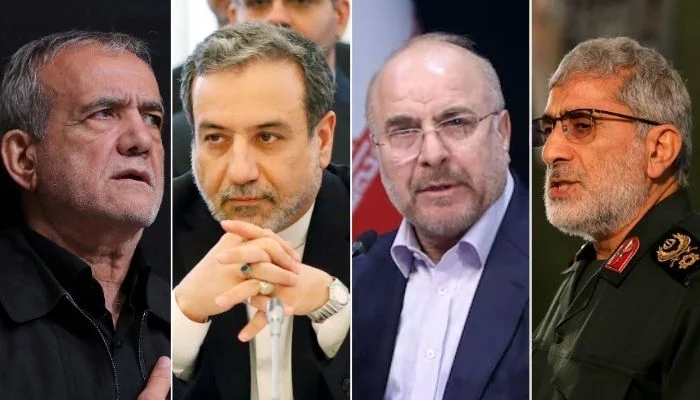
Mohammad Bagher Ghalibaf, Parliament Speaker
Many analysts consider Ghalibaf the de facto wartime leader of Iran following the assassinations of Khamenei and Larijani, especially since Mojtaba Khamenei has yet to make a public appearance. With a career spanning over three decades, Ghalibaf has held prominent roles, including commander of the Revolutionary Guards’ aerospace forces, Tehran police chief, mayor of Tehran, and now speaker of parliament. Although he’s run for president three times without success, recent reports suggested he might be engaging with the U.S., which he denied via a message on X, asserting that no negotiations have taken place and dismissing such claims as “fake news.”
President Masoud Pezeshkian
Having assumed office in 2024 following the death of ex-President Ebrahim Raisi in a helicopter crash, Pezeshkian is seen as a part of Iran’s more moderate political wing. Despite his presidency, ultimate authority rests with the supreme leader, who retains the final say on all major decisions. The workings of Iran’s power structures in the post-Ali Khamenei era remain somewhat unclear. Earlier this month, Pezeshkian personally participated in a large pro-government rally supporting Palestinian causes, taking selfies with attendees. Notably, Ali Larijani was also present at that event before his subsequent death.
Foreign Minister Abbas Araghchi
A seasoned diplomat holding a doctorate in political thought from the University of Kent, Araghchi has been Iran’s foreign minister since 2024 after the death of Hossein Amir Abdollahian in the same helicopter crash that took Raisi. He recently engaged in talks with U.S. envoys Steve Witkoff and Jared Kushner in Oman, which aimed to de-escalate tensions but ultimately failed. Reports from the New York Times claim that Araghchi and Witkoff have maintained direct communication in recent days, acting as “essential probes” to assess prospects for reducing hostilities. While outspoken in media interviews defending Iran’s stance, Araghchi’s role does not necessarily mark him as the top decision-maker.
Revolutionary Guards Commander-in-Chief Ahmad Vahidi
Veteran of Iran’s interior and defense ministries, Vahidi is the third person to serve as commander-in-chief of the Guards’ ideological army within less than a year. His predecessor, Hossein Salami, was killed during Israel’s 12-day assault on Iran in June 2025, following the assassination of Mohammad Pakpour on the war’s first day. Vahidi has remained notably absent from public appearances during this conflict, with only one official statement on March 19 expressing condolences for the death of Militia Commander Gholamreza Soleimani in an airstrike.
Quds Force Commander Esmail Ghaani
Ghaani took over the Quds Force after its previous leader, Qassem Soleimani, was killed in a U.S. drone strike in Iraq in 2020. Although he was reportedly killed earlier in June 2025, he re-emerged publicly later, fueling speculation about his current state and standing within the Iranian military hierarchy. Reports suggest he may have come under pressure due to intelligence shortcomings, including the 2024 Hezbollah chief Hassan Nasrallah assassination in Lebanon.
These figures are all vying for influence behind the scenes as Iran navigates intense regional and international conflicts.
 ChatGPT
 Perplexity
 Gemini AI
 Grok AI