Select Language:
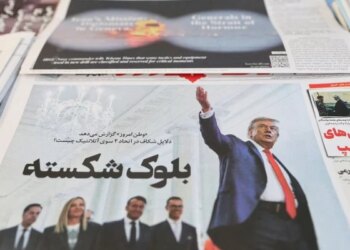
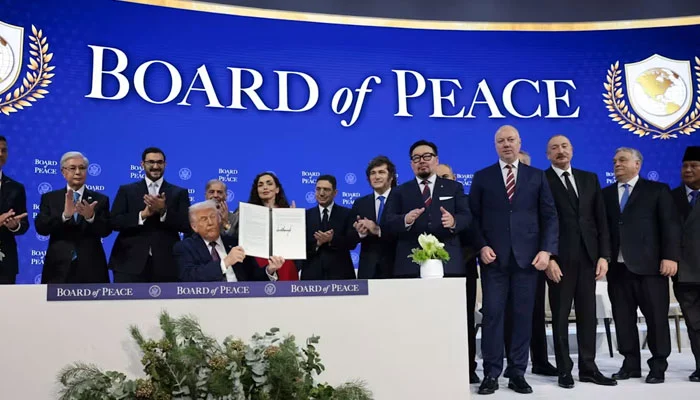
WASHINGTON: President Donald Trump will lead the inaugural session of his newly formed “Board of Peace” this Thursday. The initiative has garnered support from Trump’s allies but also faces criticism from nations concerned it could weaken the United Nations’ influence.
What is the ‘Board of Peace’?
Trump announced the idea last September amid his efforts to end the conflict in Gaza involving Israel. He subsequently expanded the board’s mission to address conflicts globally, with himself as chair. Traditionally, such conflict resolution efforts fall under the United Nations’ responsibilities.
Membership is limited to three-year terms unless countries pay an annual fee of $1 billion to fund the board’s activities and secure permanent membership, according to its charter.
In January, the White House appointed U.S. Secretary of State Marco Rubio, special envoy Steve Witkoff, former UK Prime Minister Tony Blair, and Trump’s son-in-law Jared Kushner to the board’s founding Executive Committee.
Which countries have joined so far?
The organization’s official X platform lists over two dozen nations as founding members, including key Middle Eastern allies of Washington.
These include Israel, Saudi Arabia, Egypt, and Qatar— which helped mediate discussions for the ceasefire between Israel and Hamas. Other regional members are Bahrain, Jordan, Kuwait, Morocco, Turkey, and the United Arab Emirates.
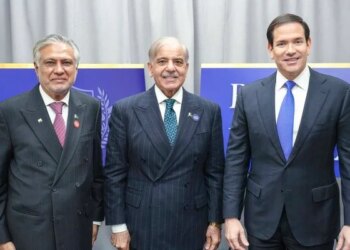
Globally, member countries also include Albania, Argentina, Armenia, Azerbaijan, Belarus, Bulgaria, Cambodia, El Salvador, Hungary, Indonesia, Kazakhstan, Kosovo, Mongolia, Pakistan, Paraguay, Uzbekistan, and Vietnam.
Remaining nations
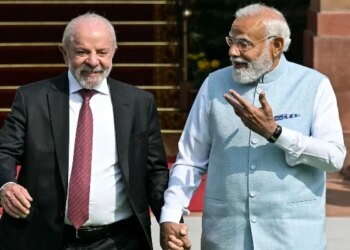
Major Western allies and significant countries from the Global South such as Brazil, India, Mexico, and South Africa have declined to join.
Leadership of the UK, European Union, France, Germany, Norway, and Sweden have announced they won’t participate.
Canada was invited but withdrew last month after disagreements over statements made by Prime Minister Mark Carney at Davos.
Brazil and Mexico cited the absence of a Palestinian representative on the board as a reason for their refusal. The Vatican also declined, asserting that the United Nations should oversee crisis management efforts.
China and Russia, both veto-wielding members of the UN Security Council, have not joined.
Board’s powers
In November, the UN Security Council approved a US-drafted resolution recognizing the board, describing it as a temporary authority to coordinate the rebuilding of Gaza until Palestinian reforms are implemented.
The resolution authorized deploying a limited International Stabilization Force in Gaza until 2027.
The board must report progress to the Security Council every six months.
China and Russia abstained, citing concerns that the resolution did not outline clear roles for the US in Gaza’s future.
Legal authority and enforcement capabilities beyond Gaza remain undefined. The board’s charter stipulates it will undertake peace-building functions in accordance with international law. Trump, as chair, holds significant powers, including veto rights and the authority to remove members, within certain limits.
Critics’ perspectives
Human rights experts have criticized the board, viewing the leadership under Trump as reminiscent of colonial structures. They also pointed out the absence of Palestinian representation, even though its mission involves overseeing Palestinian territory.
The inclusion of Tony Blair has raised eyebrows due to his role in the Iraq war and historical British imperialism in the Middle East.
Some members have questionable human rights records, including Middle Eastern nations, Belarus, and El Salvador.
Controversy surrounds Israel’s presence on a board intended to oversee Gaza, which has been devastated by Israeli military actions resulting in thousands of deaths, a humanitarian crisis, and displacement, leading human rights groups to accuse Israel of war crimes and genocide.
Inaugural meeting
Most founding members will attend Thursday’s initial gathering.
Over 20 other countries will join as observers, including close allies like Japan and South Korea, as well as India and Thailand.
Additional observers include Britain, the EU, Austria, Croatia, Cyprus, Czech Republic, Finland, Germany, Greece, Italy, the Netherlands, Poland, Romania, Slovakia, Norway, Switzerland, Mexico, and Oman.
Key issues for discussion will include Gaza’s reconstruction, humanitarian aid efforts, and the deployment of stabilization forces.
 ChatGPT
 Perplexity
 Gemini AI
 Grok AI