Select Language:
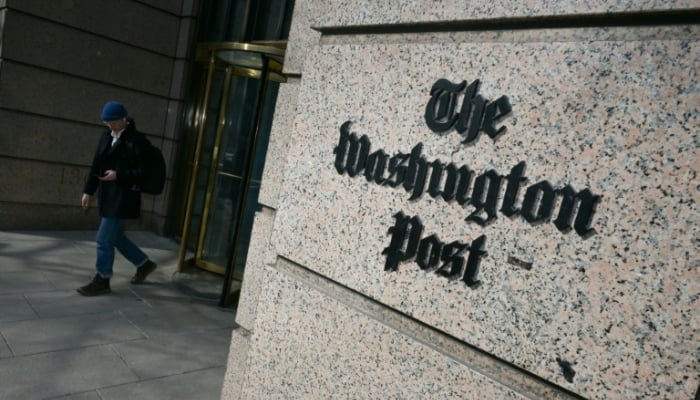
The Washington Post announced Saturday that CEO and publisher Will Lewis is stepping down immediately, just days after the newspaper—owned by Amazon founder Jeff Bezos—implemented large-scale layoffs that stirred reader outrage.
While the newspaper industry across the U.S. has been struggling with significant challenges, Lewis’s leadership faced strong criticism from both subscribers and staff during his two-year tenure, as he attempted to turn around the publication’s financial losses.
Lewis, originally from England, has been succeeded by Jeff D’Onofrio, a former CEO of Tumblr who joined the Post as CFO last year, the publication stated.
In a staff email shared on social media by one of the paper’s reporters, Lewis remarked that it was “the right time for me to step aside.” The Post simply said D’Onofrio would take over “immediately.”
The company’s recent drastic layoffs resulted in hundreds of journalists losing their jobs—including most of its international, local, and sports teams—as announced on Wednesday. While the exact number was not disclosed, The New York Times reported that about 300 out of 800 staff members were let go.
Entire regional teams, including the Middle East bureau and Kyiv-based Ukraine correspondents, were cut as the ongoing conflict with Russia persists. Departments dedicated to sports, graphics, and local news were also heavily reduced, and the daily podcast, Post Reports, was discontinued, according to local media coverage.
A protest drew hundreds to the Post’s downtown Washington headquarters Thursday.
Major newspapers like The New York Times and The Wall Street Journal have managed to adapt and remain financially stable despite these industry-wide struggles. Conversely, the Post, even with billionaire backing, has not achieved the same resilience.
In his farewell message to staff, shared on X (formerly Twitter) by White House bureau chief Matt Viser, Lewis mentioned that “difficult decisions have been made” to secure the long-term viability of the Post so it can continue to produce high-quality, nonpartisan journalism for years to come.
Bezos highlighted the paper’s opportunity, stating that its daily readers provide guidance on where to focus efforts, emphasizing the value of data in decision-making. However, both Bezos and Lewis have faced criticism for intervening directly in editorial decisions. Notably, Bezos curtailed the paper’s traditionally liberal editorial stance and blocked an endorsement of Democratic presidential candidate Kamala Harris just days before the 2024 election—breaking the supposed separation of business and editorial independence.
This move was believed to contribute to a financial decline: The Wall Street Journal reported that the Post lost around 250,000 digital subscribers after avoiding an endorsement of Harris, and the paper faced approximately a $100 million revenue reduction in 2024 due to drops in advertising and subscriptions.
President Trump’s administration has also exerted pressure on the media, filing multiple lawsuits against news organizations. Critics worry that a weakened Post may impair the press’s ability to hold the government accountable.
Former executive editor Marty Baron described the layoffs as “among the darkest days in the history of one of the world’s greatest news organizations.”
 ChatGPT
 Perplexity
 Gemini AI
 Grok AI