
Select Language:
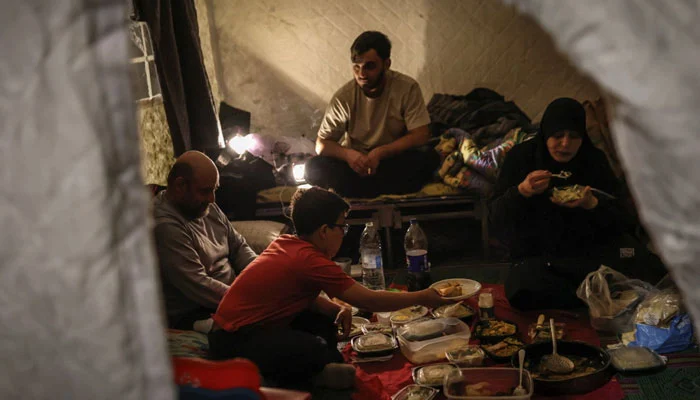
A woman in Lebanon drops marinated chicken pieces into a sizzling pan over a camping stove near her tent, as shown in a recent Reuters image.
Hassan Kiki, a 16-year-old from southern Lebanon, says he feels much older than his age after being forced to flee his home for the second time in two years due to ongoing conflict. Mourning the loss of relatives and friends, he describes war as aging him beyond his years.
“War has made us older… We’ve experienced things no one else has,” the tall teen told AFP in Beirut. “I miss going to school and seeing my friends… I lost two cousins and two friends in a massacre in Shehabiyeh,” he added, referencing an Israeli strike on his town that at least seven people died on March 11.
Since March 2, more than a million Lebanese residents have been registered as displaced, according to Lebanese authorities, as the country was pulled into a wider Middle Eastern conflict. The escalation began when Hezbollah launched rockets into Israel to avenge the death of Supreme Leader Ayatollah Khamenei.
Despite a truce in 2024 aiming to end a previous war with Hezbollah, Israel continued bombing Lebanon with widespread airstrikes, border ground operations, and warnings of evacuations across large parts of the country. For many young Lebanese caught in the crossfire, their childhood has been interrupted by ongoing crises, and many describe it as lost.
“I have no childhood anymore,” Kiki laments. “Financial losses can be recovered, but people cannot come back.” Lebanon has been suffering from a severe economic crisis since 2019, locking residents out of their bank deposits, compounded further by the COVID-19 pandemic.
The following year, a massive explosion at Beirut’s port devastated much of the capital, killing over 220 people in one of the largest non-nuclear blasts in history.
Zahraa Fares, 16, recalls her first experience with war at age 14. “We were still discovering our interests and favorite activities when we had to be displaced… and we couldn’t do anything,” she said, having fled Nabatiyeh in the south. She now finds some relief through an acting workshop at Beirut’s Lebanese National Theatre, designed to support youth affected by conflict.
Wassim al-Halabi, a 20-year-old Syrian who fled his homeland nine years ago, has found himself caught in another upheaval. Working in a restaurant since being displaced from university in 2024, he describes feeling like he’s starting over. “Our dreams are on hold until this war ends,” he says.
Since March 2, over 1,000 people have lost their lives due to Israeli strikes, including 118 children, according to Lebanese officials. Psychiatrist Evelyne Baroud warns that repeated exposure to violence and trauma places children at higher risk for developing mental health issues and post-traumatic stress disorder.
Lebanon’s tumultuous history stretches back decades, with the most devastating being the 15-year civil war that began in 1975, dividing the country along sectarian lines and killing around 150,000 people. The aftermath left enduring political divisions and an Israeli occupation of the south that lasted until 2000.
While many young Lebanese grew up hearing stories of war from their parents, few expected to live through it themselves. “My mother used to tell us about displacement and airstrikes, but I couldn’t truly imagine it,” Fares shared. “Now I see it firsthand.”
In Beirut, 18-year-old Laura al-Hajj reflects on the burdens carried across generations. “Why do I have so many worries at my age?” she wonders. “We’ve faced conflicts far beyond our years… I only worry about making it through tomorrow.” She believes that ongoing wars are becoming a tragic pattern passed down through families. “No child should endure what we’ve been through,” she emphasizes.
 ChatGPT
 Perplexity
 Gemini AI
 Grok AI