Select Language:
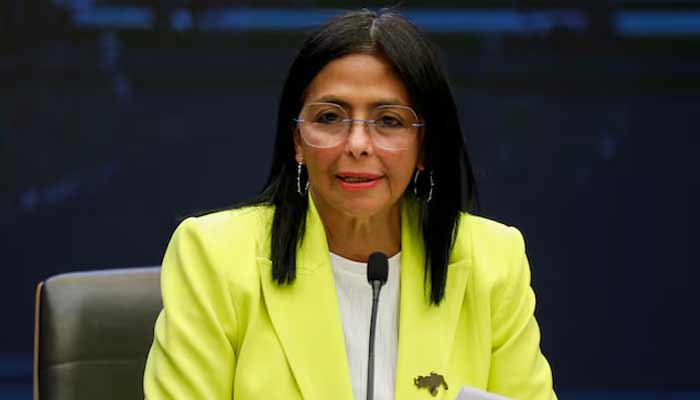
Venezuela’s Vice President and Oil Minister Delcy Rodriguez speaks to the press in Caracas. — Reuters/File
– Rubio states that it is “premature” to discuss new polls in Venezuela.
– Streets remain calm as people wait for further developments.
– The vice president has assumed interim leadership of the country.
A senior Venezuelan official affirmed on Sunday that the government would remain united behind President Nicolas Maduro. His detention by the U.S. has created significant uncertainty about the country’s future, especially given its status as an oil-rich nation in South America.
Maduro is currently held in a New York detention facility, scheduled for a court appearance Monday on drug-related charges. The U.S. president, Donald Trump, ordered his arrest and claimed control over Venezuela. Meanwhile, Caracas officials loyal to Maduro, who have labeled the arrests of Maduro and his wife, Cilia Flores, as kidnapping, continue to hold power.
Interior Minister Diosdado Cabello reassured supporters via an audio message released by the ruling socialist party, PSUV, emphasizing the nation’s unity: “Here, the unity of the revolutionary force is more than guaranteed, and here, there is only one president—Nicolas Maduro Moros. Let no one fall for the enemy’s provocations.”
Images of Maduro, 63, blindfolded and handcuffed on Saturday shocked Venezuelans, marking Washington’s most contentious intervention in Latin America since the invasion of Panama in 1989.
Vice President Delcy Rodriguez, who also serves as Oil Minister, has temporarily assumed the presidency with judicial approval, although she maintains Maduro’s status as president. Known for her pragmatic approach due to her ties to the private sector and oil expertise—the country’s chief revenue source—she has publicly rejected Trump’s claims that she is willing to collaborate with the U.S.
Venezuela’s government has long accused Trump’s pressure campaign of attempting to seize its vast natural resources, particularly oil. They pointed out Trump’s recent statements about U.S. oil companies moving into Venezuela as evidence of this intent.
Cabello, with close military ties, voiced outrage, asserting, “In the end, it was all about our oil being the real prize.”
Venezuela’s state oil firm, PDVSA, is instructing some joint ventures to reduce crude production by shutting down oil fields or groups of wells amid a halt in exports. This shutdown follows last month’s U.S. sanctions, including a blockade on Venezuelan oil tankers and the seizure of two shipments.
The country, once among Latin America’s wealthiest, has seen its economy collapse under Maduro’s leadership, pushing approximately 20% of its population to flee, creating one of the world’s largest exoduses.
### US Expresses Willingness to Engage with New Authorities
Secretary of State Marco Rubio indicated that the Trump administration intends to work with the current Venezuelan leadership, clarifying that the U.S. is not pursuing total regime change. Rubio stressed that the U.S. is focused on combating drug trafficking, not waging war against Venezuela.
His comments responded to earlier statements from Trump, who suggested that the U.S. might take control of the country until a transition occurs, hinting at the potential for military intervention.
Rubio emphasized during multiple Sunday interviews that Washington’s goal is not upheaval but cooperation, provided that Venezuela’s government complies with U.S. demands. He added that discussions about new elections are premature and that the focus remains on the current situation.
### Streets Remain Muted
Despite the tense atmosphere, opposition figures are cautious about celebrating Maduro’s detention. On Sunday, security presence appeared lighter than usual. Some bakeries and coffee shops operated normally, and pedestrians, joggers, and cyclists went about their routines. Many Venezuelans were seen restoring supplies at local stores.
A single mother in oil-rich Maracaibo explained her prudence: “Yesterday, I was afraid to go out, but today I had to. I was without food, and I need to figure things out. Venezuelans are used to enduring fear. If this helps my son grow up in a free country, I will bear it.”
Similarly, a supermarket owner in Maracaibo noted that his store remained closed Saturday after U.S. special forces reportedly seized Maduro from military bases in Caracas and other locations.
“We’ll be open until noon today. Many neighborhoods lack access to food, and we want to help,” he said.
The opposition has expressed disappointment over Trump’s dismissal of Maria Corina Machado, a 58-year-old opposition leader and Nobel Peace Prize recipient, as a potential interim leader. Trump claimed she lacks sufficient support, despite her advocacy and the opposition’s belief that her ally, Edmundo Gonzalez—who reportedly won the recent election—has a democratic mandate.
Uncertainty surrounds how Trump plans to manage Venezuela’s ongoing crisis, with some critics wary of foreign intervention and its implications. While Western nations generally oppose Maduro, there is widespread call for diplomacy and respect for international law. Questions also arise about the legality of foreign heads of state being detained.
The UN Security Council is scheduled to meet Monday to discuss the U.S. actions, which Secretary-General Antonio Guterres warned could set a dangerous precedent. Major backers of Venezuela, Russia and China, have criticized the U.S. move.
Maduro has faced U.S. charges, including narco-terrorism conspiracy, since 2020. He has consistently denied any criminal involvement.
 ChatGPT
 Perplexity
 Gemini AI
 Grok AI