Select Language:
Venezuela announced it has started negotiations with the United States to restore diplomatic relations, just days after U.S. forces ousted Nicolás Maduro from power. This move signals a step toward cooperation following the detention of Maduro and U.S. President Donald Trump’s assertion that he is now “in charge” of the South American nation.
U.S. diplomats are currently in Caracas to discuss the reopening of Venezuela’s embassy, while in Washington, Trump has met with oil executives to explore gaining access to Venezuela’s extensive crude oil reserves. Foreign Minister Yvan Gil stated that Interim President Delcy Rodríguez’s government has decided to initiate an exploratory diplomatic process aimed at re-establishing formal relations with the U.S., including the reopening of embassies in both countries.
John McNamara, the top U.S. diplomat in neighboring Colombia, along with other staff, traveled to Caracas for an initial assessment regarding a phased resumption of diplomatic activities, a U.S. official explained on condition of anonymity. Venezuela responded by promising to send a delegation to Washington.
Rodríguez condemned what she called “the serious, criminal, illegal, and illegitimate attack” by the United States and vowed that Venezuela would continue to confront what she termed “this aggression” through diplomatic channels.
Earlier Friday, Trump announced he had canceled a second round of provocative actions against Venezuela due to the release of some prisoners. Despite previous hints that force might be used to influence events in Venezuela—a country with the world’s largest proven oil reserves—Trump emphasized efforts to encourage U.S. oil companies to invest in Venezuela’s oil industry. However, ExxonMobil’s CEO, Darren Woods, urged caution, characterizing Venezuela as “uninvestable” without significant reforms.
Trump highlighted that foreign companies would only engage with Washington, not Caracas, regarding oil operations. He also claimed that U.S. firms had committed to investing $100 billion in Venezuela, whose infrastructure has suffered from years of mismanagement and sanctions, and that the U.S. planned to sell 30 to 50 million barrels of Venezuelan crude, with proceeds to be used at the president’s discretion. Any funds sent to Caracas would be dedicated solely to purchasing U.S.-made products.
Meanwhile, U.S. authorities maintained maritime pressure on Venezuelan oil tankers in the Caribbean, having seized a vessel carrying Venezuelan crude—an operation Trump described as a “first successful joint operation” with Caracas. Venezuelan state oil company PDVSA confirmed that one ship was returning to Venezuelan waters.
Families gathered outside Venezuelan jails, awaiting the release of political prisoners—an action Washington credited itself for facilitating. One woman, Dilsia Caro, 50, expressed her relief upon learning her husband, Noel Flores, was to be released after being detained for criticizing Maduro.
Venezuela began releasing prisoners on Thursday, marking the first such movement since U.S. forces detained Maduro during a deadly raid on January 3. Trump indicated he will meet next week with opposition leader María Corina Machado, whom he previously dismissed for lacking the “respect” to lead Venezuela.
Exiled opposition figure Edmundo González Urrutia insisted that any democratic transition must recognize his claim to victory in the 2024 elections, which Maduro’s re-election—widely regarded as fraudulent—had declared him the winner. Meanwhile, González hopes for the release of his son-in-law, who has been detained in Caracas for a year.
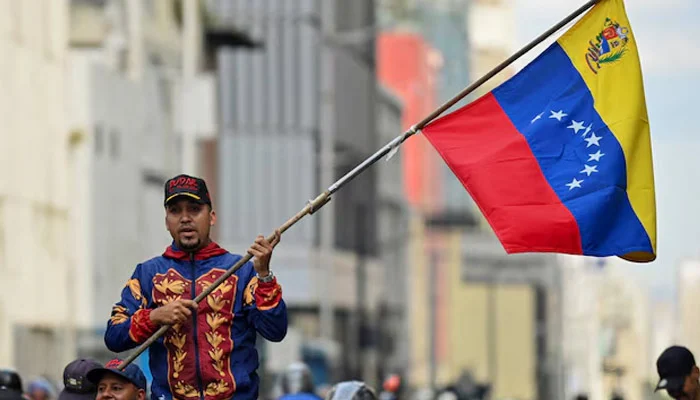
In Caracas, thousands of protestors gathered, demanding Maduro’s release in daily demonstrations. Maduro was previously captured during a raid involving U.S. special forces and airstrikes, which resulted in over 100 deaths. Authorities claimed Maduro and his wife, Cilia Flores, were transported to New York for trial on drug trafficking and other charges. Despite this, Foreign Minister Yvan Gil maintained that Venezuela was “not subordinate or subjugated,” even as he pledged cooperation with the U.S.
The protests reflected ongoing tensions, with many Venezuelans opposing any form of U.S. intervention, especially after the attack that resulted in loss of life. One protester, 70-year-old Josefina Castro, called for independence from U.S. influence, lamenting the sacrifices made and condemning what she described as the damage caused by the raid.
 ChatGPT
 Perplexity
 Gemini AI
 Grok AI