Select Language:
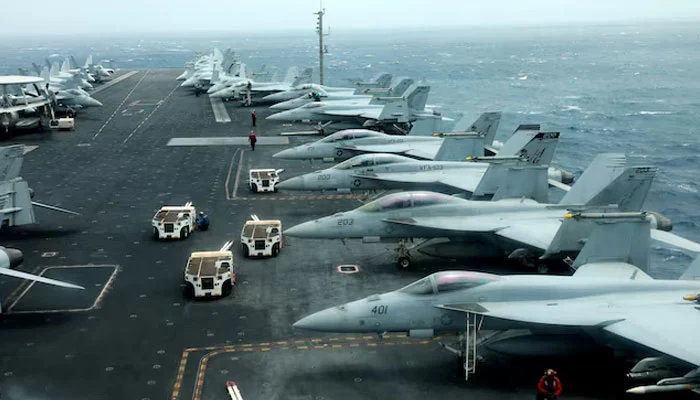
A U.S. military aircraft carrier strike group, along with additional assets, is scheduled to arrive in the Middle East in the upcoming days, according to two U.S. officials on Thursday. This development comes even as President Donald Trump expressed a desire to avoid resorting to new military interventions against Iran.
Last week, U.S. warships—including the aircraft carrier USS Abraham Lincoln, several destroyers, and fighter jets—began repositioning from the Asia-Pacific region amid escalating tensions between Iran and the United States. The tensions have intensified following a harsh crackdown on protests within Iran in recent months.
One official mentioned that the U.S. is also considering deploying extra air defense systems to the Middle East. Historically, the U.S. tends to bolster its military presence in the region during periods of increased tension—moves typically viewed as purely defensive, according to experts.
In summer of last year, the U.S. conducted a significant military buildup prior to carrying out strikes against Iran’s nuclear facilities in June. The U.S. publicly acknowledged that it kept its plans for potential strike actions secret.
Despite threats from Trump about possible military action over recent protests in Iran—where demonstrations have since diminished—his rhetoric on the matter appears to have softened. Trump has shifted his focus toward other international issues, including his interest in Greenland.
On Wednesday, Trump stated that he hopes there won’t be any further U.S. military operations in Iran but emphasized that the U.S. would act if Iran resumed its nuclear activities. “They can’t develop nuclear weapons,” he told CNBC in Davos, Switzerland. “If they do, it’s going to happen again.”
It’s been at least seven months since the International Atomic Energy Agency last confirmed Iran’s stockpile of highly enriched uranium. The agency’s guidelines recommend monthly inspections, yet this has not occurred recently. Iran is required to submit reports to the IAEA detailing any damage at U.S. strike sites and information about nuclear materials, such as approximately 440.9 kg of uranium enriched to nearly 60%, close to weapons-grade levels of around 90%. This quantity, if further enriched, could potentially produce enough material for 10 nuclear bombs, as per IAEA assessments.
Uncertainty remains whether protests in Iran will surge again. That movement began on December 28 as modest protests in Tehran’s Grand Bazaar over economic challenges, quickly spreading nationwide.
 ChatGPT
 Perplexity
 Gemini AI
 Grok AI