Select Language:
The White House announced Thursday that diplomacy remains President Donald Trump’s top priority in handling Iran. He will wait to see if a deal can be achieved during high-stakes negotiations but has also stated that military options are available if needed.
Preparations are underway for Friday’s meeting in Oman amidst rising tensions as the U.S. increases military presence in the Middle East—referred to by Trump as a “massive armada”—while regional countries work to prevent escalation into a broader conflict.
Despite disagreements over the agenda—particularly whether Iran’s missile program and other issues should be on the table—talks are proceeding, though skepticism remains about reaching an agreement. Trump has warned Iran that he is prepared to order strikes if negotiations fail.
The U.S. has clarified its desire for discussions to address Iran’s missile capabilities and other concerns, whereas Tehran insists negotiations focus solely on its nuclear program. It’s unclear if this divergence has been resolved.
White House spokesperson Karoline Leavitt emphasized that diplomacy is always Trump’s first line of action and reiterated his demand for zero nuclear capability from Iran. She added, “He wants to see if a deal is possible,” and warned Iran that the president’s military options remain available.
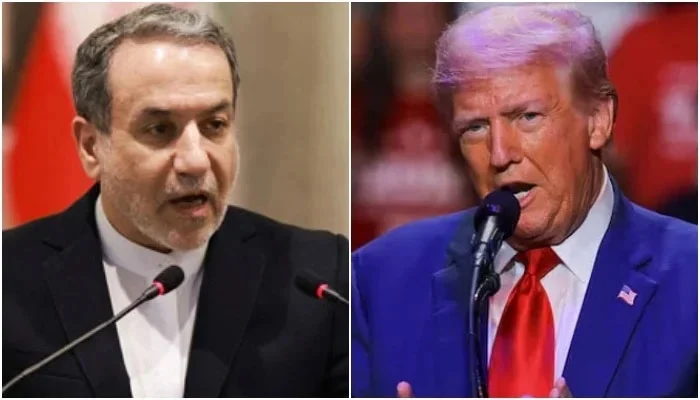
Iran’s Foreign Minister Abbas Araqchi left for Oman on Thursday. His spokesperson, Esmail Baghaei, said Tehran aims to engage in the talks with seriousness to reach a “mutually acceptable and dignified understanding” on its nuclear program, hoping America will participate responsibly.
In Muscat, Araqchi is expected to meet with Trump’s special envoy Steve Witkoff and Jared Kushner, the president’s senior advisor and son-in-law.
On the eve of negotiations, Iran’s state broadcaster reported that one of its most advanced long-range ballistic missiles, the Khorramshahr 4, has been deployed at an underground Revolutionary Guards’ missile site. The missile has a range of 2,000 km (about 1,240 miles) and can carry a warhead weighing up to 1,500 kg (around 3,300 pounds).
The U.S. has pressured Iran to limit its missile range significantly.
Tensions have prompted efforts by regional governments to de-escalate. Turkish President Tayyip Erdogan announced his government is actively working to prevent U.S.-Iran conflicts from sparking a new regional war. Erdogan has fostered close ties with Trump and is expanding Turkey’s diplomatic influence across the Middle East.
Speaking while returning from Egypt, Erdogan suggested that high-level US-Iran talks would be helpful after lower-level negotiations scheduled in Oman.
The week’s escalation was fueled by uncertainty over the venue and format of the talks, following Iran’s recent crackdown on protests. Trump publicly told NBC that Iran’s Supreme Leader Khamenei “should be very worried,” asserting, “Yeah, he should be.”
Meanwhile, the location for the discussions was shifted from Istanbul to Muscat after initial agreements.
German Chancellor Friedrich Merz voiced concern about potential conflict escalation in the Gulf region during his meetings with regional officials. He called on Iran to cease aggressive actions and help stabilize the area.
Gulf Arab states worry that Iran might carry out threats to target U.S. military bases on their soil if the U.S. attacks Iran. China expressed support for Iran’s rights to peaceful nuclear development and criticized threats of force and sanctions.
Iran insists its nuclear pursuits are peaceful. However, the U.S. and Israel accuse Iran of trying to develop nuclear weapons and have increased military deployments to the Middle East, including aircraft carriers, warships, fighter jets, spy planes, and refueling tankers.
Trump has warned of “bad things” happening if a suitable deal isn’t reached, signaling readiness to act if necessary.
 ChatGPT
 Perplexity
 Gemini AI
 Grok AI