Select Language:
- U.S. forces targeted a vessel linked to a Colombian rebel group, according to Hegseth.
- Trump alleges Petro supports drug production and halts U.S. aid payments.
- Relations between the U.S. and Colombia deteriorate over military operations and visa cancellations.
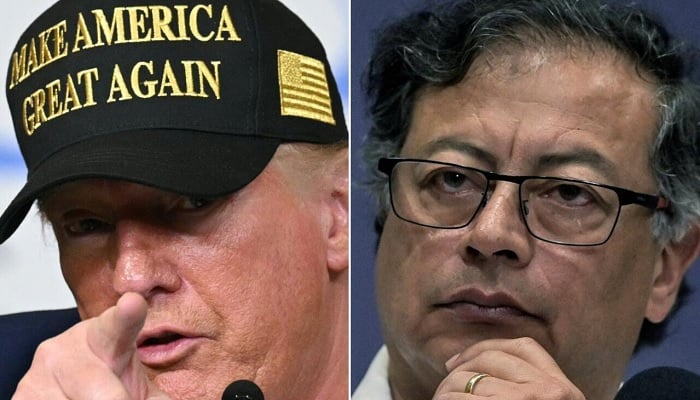
On Sunday, U.S. military forces struck a vessel connected to a Colombian leftist rebel organization, Defense Secretary Pete Hegseth reported. The same day, President Donald Trump labeled Colombian President Gustavo Petro as an “illegal drug leader” and announced that aid payments to Colombia would be suspended.
These remarks mark a new low in U.S.-Colombia relations, which have become tense since Trump took office again in January. Tensions have increased following the U.S. administration’s recent series of strikes against vessels suspected of transporting drugs in the Caribbean.
Hegseth shared on X that the Pentagon destroyed a vessel and killed three individuals on Friday in the USSOUTHCOM zone—covering the Caribbean—claiming the vessel was affiliated with the Marxist guerrilla group known as the National Liberation Army and was involved in drug smuggling, though no evidence was provided.
The Pentagon declined to comment further beyond Hegseth’s statement.
Colombia Responds to Trump’s Remarks
Colombia’s Foreign Ministry denounced Trump’s comments as offensive and a violation of the nation’s sovereignty. The ministry committed to rally international support to defend Petro and Colombia’s independence.
“These accusations are very serious and threaten the dignity of the Colombian president,” the statement read.
Hegseth’s post came just hours after Trump criticized Petro on social media, declaring that U.S. aid and subsidies to Colombia would be halted.
“President Gustavo Petro, of Colombia, is an illegal drug trafficker encouraging widespread drug cultivation across Colombia,” Trump wrote on Truth Social.
“The purpose of this drug production is to flood the U.S. market, causing death and destruction,” he added.
Reuters wasn’t able to immediately verify which payments Trump referenced. Colombia used to be among the top recipients of U.S. aid in the Western Hemisphere, but aid flows have been drastically reduced this year following the closure of USAID, the U.S. government’s humanitarian agency.
The U.S. State Department directed inquiries elsewhere, and the White House didn’t respond immediately.
Spiraling Tensions
Last month, the U.S. revoked Petro’s visa after he participated in a pro-Palestinian protest in New York and urged U.S. troops to disobey Trump’s orders.
U.S. military strikes on Caribbean vessels have also sparked outrage in Colombia. Experts and human rights advocates have condemned the operations, with Amnesty International accusing them of “murder on the high seas.”
Earlier this month, Petro claimed that one of the strikes hit a Colombian ship, a statement the Trump administration denied.
Petro denounced the latest bombing, asserting the vessel belonged to a modest family rather than the National Liberation Army. He also pushed back against Trump’s accusations.
“Mr. Trump, Colombia has never been rude to the United States, but your comments are rude and ignorant,” Petro responded on X. “I am not a businessman, nor a drug trafficker. My heart is not motivated by greed.”
Colombia continues to struggle with its drug issues. Last year, Petro vowed to control coca cultivation through extensive social and military efforts, but the strategy has seen limited success.
In September, Trump designated Colombia along with Afghanistan, Bolivia, Myanmar, and Venezuela as countries that have “failed to uphold their anti-drug commitments” over the past year.
 ChatGPT
 Perplexity
 Gemini AI
 Grok AI